You probably know that mouth-to-mouth resuscitation has always been a prominent component of CPR. However, in recent years, experts have changed the process to emphasize the highest-priority method -- chest compressions -- and to make layperson-conducted CPR more effective.
The steps for performing CPR used to follow the acronym "A-B-C" -- airway, breathing and circulation. But as we discussed earlier, CPR should now be performed C-A-B -- circulation, airway and breathing. The American Heart Association introduced this new approach in 2010 as a way to make chest compressions the priority of CPR.
If you take classes to learn advanced CPR methods, you'll be trained to provide airway and breathing support to a victim. If you are untrained, however, you should focus only on the circulation step.
For this method, known as hands-only CPR, you essentially become a surrogate heart to pump oxygenated blood to the rest of the victim's body. How can you have any effect on blood flow from outside of the body? All it takes is your hands and some strength. The steps are simple and include the following:
- While kneeling near the victim's neck and shoulders, place the heel of your hands one atop the other in the center of the person's chest (midway between the nipples). Keep your elbows straight and your shoulders positioned over the same area as your hands.
- Using the weight of your upper body (rather than just your arms), push the chest down. You should try to compress his or her chest 1 to 2 inches (2.54 to 5.08 cm).
- Push hard, and aim to complete at least 100 (or more) compressions per minute. To keep the appropriate speed and pace, try the mnemonic technique of singing "Stayin' Alive" by the Bee Gees and match the chest compressions to the pace of the song. This particular disco classic has 103 beats per minutes and can stay in your head easily as you perform CPR [source: Fox News].
- If your victim is a baby, use two fingers rather than two hands to compress the middle of the chest, and be less aggressive with your compressions -- about 1.5 inches (4 cm) deep. Still try to complete at least 100 in one a minute, just as you would with an adult [source: Mayo Clinic].
In reality, all you are doing is squeezing the heart between the breastbone and the backbone to force blood out. Compressing the chest creates positive pressure inside the chest that pushes oxygenated blood out of the heart through the aorta. From here, it travels to the brain and then on to other parts of the body, delivering oxygen for cellular respiration.
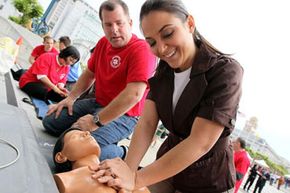
It may sound easy enough in theory, but when someone collapses in front of you, your first reactions can be confusion and terror. But while you're panicked and unable to act, valuable minutes are slipping away. To counter this, many organizations, such as the American Red Cross, offer classes that give you hands-on practice to hone your CPR skills. There are even online sites, like HandsOnlyCPR.org, that simulate the compression-only method online and help you learn the speed and rhythm at which you need to perform it.
Keep reading to learn more about the difference between CPR and defibrillation.