
Dreaming and the Brain
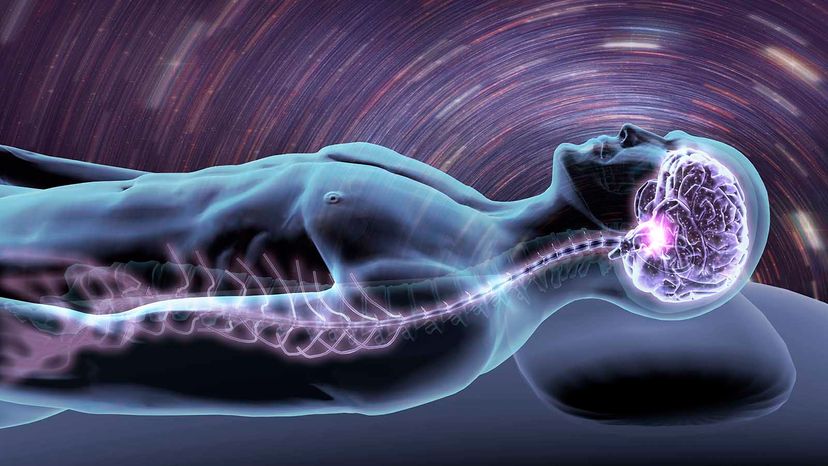
There are four stages of sleep. Previously, there were five stages, but in 2007 Stages 3 and 4 were combined. The first three stages compose non-rapid eye movement sleep (NREM). Stage 1 of NREM sleep is a short, light sleep characterized by slow eye movement and the appearance of theta waves.
In stage 2, the muscles become more relaxed. Electroencephalography (EEG) recordings show sleep spindles — bursts of rhythmic brain wave activity — and K-complexes, or brief, high-amplitude waves.
Advertisement
Stage 3, also known as slow-wave sleep, is the deepest stage of NREM sleep. During this stage, delta waves emerge, and the brain is less responsive to external stimuli. It is difficult to wake the sleeping person. Our brain activity throughout these stages is gradually slowing down so that by deep sleep, we experience nothing but delta brain waves, the slowest brain waves (see sidebar).
After stage 3, about 90 minutes after we go to sleep, we begin rapid eye movement sleep (REM sleep). REM sleep is primarily characterized by movements of the eyes and is the fourth stage of sleep. Other mammals, birds and reptiles exhibit REM sleep, too.
Eugene Aserinsky, a graduate student in physiology at the University of Chicago, and physiologist Nathaniel Kleitman discovered REM sleep in 1953. They found that the brain is in an active waking state during REM sleep, and that it alternated with quiescent sleep periods. The discovery of REM sleep kickstarted a flurry of scientific research into the mechanisms of the sleeping brain.
During REM sleep, several physiological changes also take place. The heart rate and breathing quickens, and blood pressure rises. We can't regulate our body temperature as well, and our brain activity increases to the same level as when we are awake. The rest of the body, however, is essentially paralyzed until we leave REM sleep.
According to a 2012 study in rats at the University of Toronto, this paralysis occurs when the neurotransmitters gamma-aminobutyric acid (GABA) and glycine turn off activity in the motoneurons (neurons that conduct impulses outward from the brain or spinal cord). Because REM sleep is the sleep stage at which most dreaming takes place, this paralysis could be nature's way of making sure we don't act out our dreams physically. Otherwise, if you're sleeping next to someone who is dreaming about playing kickball, you might get kicked repeatedly while you sleep.
Throughout the night, we go through these four stages several times. Each subsequent cycle, however, includes more REM sleep and less deep sleep (stage 3). As a typical adult nears the end of their sleep episode, REM sleep increases, and stage 2 accounts for the majority of NREM sleep.
Sleep patterns do change as we age, though. The total amount of time we spend sleeping decreases (though we require the same amount of sleep from our 20s into old age); the proportion of time we spend in slow-wave sleep and REM sleep decreases; and our ability to maintain sleep decreases. That said, a person's sleep architecture, or basic structure of normal sleep, varies depending on age.
Although most dreams take place during REM sleep, dreams can occur during any of the sleep stages. Most NREM dreams, however, don't have the intensity and narrative structure of REM dreams. And we're most likely to remember dreams we have during REM sleep. The length of dreams vary. It's hard to tell exactly how long they last, but we dream multiple times a night, and dreams likely last anywhere from a few minutes to more than 30 minutes. We may spend around two hours dreaming each night.
In the next section, we'll look at some of the major dream theorists and what they say about why we dream.