
How Do You Get the Flu Virus?
Flu season in North America runs from November through March, but dates can vary from year to year. January and February tend to be the most active flu months.
During flu season, people begin coming down with the illness, and they quickly spread it to friends, family and coworkers. Schools are particularly notorious for spreading the flu, because students are in such close quarters. And when a child picks up the virus, he or she often brings it home and shares it with the rest of the family. The National Institute of Allergy and Infectious Diseases estimates that one out of every three families of school-aged children is infected with the flu each year.
Advertisement
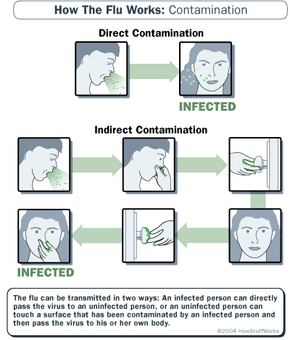
The flu is highly contagious. It is spread primarily by coughing and sneezing (which people who have the flu tend to do a lot of). Let's say you have the flu virus. Every time you cough or sneeze, you release tiny droplets of fluid into the air. Those tiny droplets can fly pretty far -- up to 3 feet (about 1 meter). If some of those droplets land on the nose or mouth of a person standing nearby, that person is likely to get as sick as you are, usually within one to four days. You can also spread the virus if you touch something (like a doorknob or table) after you've sneezed or coughed into your hand, and then other people come along and touch the same doorknob or table and put their hand on their nose or mouth.
If you have the flu, you're not just contagious when you have symptoms. You can pass along the virus one day before you start sniffling and sneezing, and you can keep passing it along for seven days after you start sniffling and sneezing. Children can be contagious even beyond the seven days.