How to Exercise During Pregnancy

by Elizabeth Eden, MD

Pregnancy Exercise Overview

Being pregnant doesn't necessarily mean getting fat. And it doesn't have to mean being tired all the time. The way you feel (terrific or fatigued) and the way you look during pregnancy and as a new mother (sleek or bulgy) depend to a great extent on actions you take during pregnancy regarding diet and exercise. By eating a wide variety of wholesome foods and by exercising on a regular basis, you can maintain or improve your fitness and health during this time of extra demands on your body.

Follow these instructions and learn how to exercise safely during pregnancy.
2006 Publications International, Ltd.
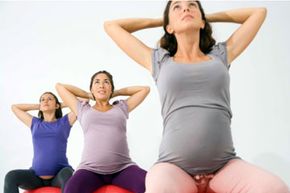
Exercise is an important part
of a healthy pregnancy.

Decide how you want to look and feel after delivery. Then accept the challenge of making necessary changes in eating and exercise to achieve that goal. Sensible eating and regular exercise go hand in hand. Just because you're pregnant doesn't mean you're fragile.

Look at your schedule and try to give your exercise time top priority. Consider planning your day around your exercise program, not the other way round.

This article describes a safe and effective exercise program for pregnant women at any level of fitness. The emphasis is on aerobic exercise, (although non-aerobic exercise can be beneficial, too, if done regularly) with some discussion of the other important components of a complete fitness program-stretching and strengthening exercises. Before starting on any exercise program, however, you should consult with your doctor and make sure that the exercise programs are right for you.

In the following sections, you will find all of the tools that you need to get started on a program that will keep you looking and feeling great through your pregnancy, including:

  • Starting a Prenatal Exercise Program

    During pregnancy, your body undergoes significant changes. Before beginning an exercise program, it is important to understand how to modify an existing exercise routine or start a new one safely. These simple guidelines will get you started on the right track to working out in the healthiest way possible.

  • Prenatal Exercise Safety

    While exercise is important during pregnancy, there are many safety concerns that you will have to keep in mind. It is important to pay close attention to what you eat, what you wear, and the exercises you do. Read these guidelines and consult with your doctor to make sure you are exercising safely.

  • Aerobic Exercises During Pregnancy

    Building up and maintaining cardiovascular endurance is essential for the pregnant woman. She must, however, avoid unnecessary strain. Follow these guidelines for a safe, effective aerobic workout for pregnant women.

  • Strength-Training Exercise During Pregnancy

    Developing muscle tone is important not only for looking and feeling good, but also for easing the strain of labor and delivery. These exercises build muscles that will help you through the birth process.

  • Choosing a Pregnancy Exercise Class

    As a pregnant woman, you need to evaluate exercise classes in a different way. It is vital that you have a well-trained instructor. Here is a set of guidelines that will help you find the best class for you.

To learn more about the topics covered in this article, try the following links:

  • Prenatal Vitamins will tell you everything you need to know about these pills commonly prescribed to expectant mothers and how they affect both mom and the baby.
  • To learn about what types and quantities of foods to eat while pregnant, try Pregnancy Nutrition Guidelines.
  • To find out more about pregnancy in general, read How Pregnancy Works.
  • To find out more about other prenatal procedures, go to How Prenatal Testing Works.
This information is solely for informational purposes. IT IS NOT INTENDED TO PROVIDE MEDICAL ADVICE. Neither the Editors of Consumer Guide (R), Publications International, Ltd., the author nor publisher take responsibility for any possible consequences from any treatment, procedure, exercise, dietary modification, action or application of medication which results from reading or following the information contained in this information. The publication of this information does not constitute the practice of medicine, and this information does not replace the advice of your physician or other health care provider. Before undertaking any course of treatment, the reader must seek the advice of their physician or other health care provider

Starting a Prenatal Exercise Program

Becoming fit during pregnancy requires safe, regular, sustained, moderate exercise -- now is not the time to embark on a new sport or engage in strenuous workouts. Even if you have never exercised regularly before, you can safely begin a workout program during pregnancy.

The safest and most productive activities during pregnancy (especially for the woman exercising for the first time) are swimming and walking. These exercises are best because they can usually be continued until almost the day of delivery, and they carry little risk of injury that would prevent further exercising. Talk with your doctor about how much exercise you can safely perform. Then all you need before beginning is a sound exercise program and appropriate clothing.


Continuting Your Current Program

Most health care providers agree that if you are already regularly engaged in a sport or an exercise program when you become pregnant, you can continue it during pregnancy. Depending on the activity, you may need to modify, slow down, or change activities due to fatigue in early pregnancy or due to added weight and the normal softening of joint ligaments as your pregnancy advances.

Your body is your best guide and usually responds with pain or fatigue if an activity becomes inappropriate. Pay attention to these signals. Be especially aware of your lower back, hip joints, and pelvis-they are your most vulnerable areas.

Learn how to exercise during pregnancy using safe, doctor-recommended techniques.
�2006 Publications International, Inc.
Be sensitive to any sensations of pain or fatigue when exercising, which mean you need to stop or modify the exercise.

General Exercise Guidelines
  • Exercise regularly. You can't make up for lost time, and you shouldn't push too hard to catch up. Plan ahead and take this special time for yourself without fail. Make exercise a habit! (Remember The Half- Life of Exercise Theory: When more than two and a half days elapse between exercise sessions for the same muscle group, you lose the benefits of the first exercise session!)

  • Stop if you feel pain. Modify your exercise program if necessary or substitute other forms of exercise. Check with your physician before resuming your program, but do so right away -- don't waste precious time.

  • Finish eating at least 1 to 11/2 hours before working out. Otherwise, you may experience burping, belching, or abdominal discomfort as a consequence of exercising on a full stomach.

  • Drink water before, during, and after your work -- out -- even if you aren't thirsty. It's very important to replace the liquids lost through exertion. Without sufficient fluid, your body becomes slow to react and easily fatigued. And it's best to drink four to eight ounces frequently, rather than taking one long drink.

  • Don't go on a calorie-restriction diet during pregnancy. This is very dangerous for your baby. Eat a nutritious, balanced diet.

To learn more about the topics covered in this article, try the following links:

  • Prenatal Vitamins will tell you everything you need to know about these pills commonly prescribed to expectant mothers and how they affect both mom and the baby.
  • To learn about what types and quantities of foods to eat while pregnant, try Pregnancy Nutrition Guidelines.
  • To find out more about pregnancy in general, read How Pregnancy Works.
  • To find out more about other prenatal procedures, go to How Prenatal Testing Works.
This information is solely for informational purposes. IT IS NOT INTENDED TO PROVIDE MEDICAL ADVICE. Neither the Editors of Consumer Guide (R), Publications International, Ltd., the author nor publisher take responsibility for any possible consequences from any treatment, procedure, exercise, dietary modification, action or application of medication which results from reading or following the information contained in this information. The publication of this information does not constitute the practice of medicine, and this information does not replace the advice of your physician or other health care provider. Before undertaking any course of treatment, the reader must seek the advice of their physician or other health care provider.

Prenatal Exercise Safety

Every pregnant woman should consult her physician before beginning an exercise program. Discuss which exercises are effective yet safe and those to avoid. It is particularly important that you not begin exercising on your own if:

Exercising while pregnant can provide significant health benefits, but there are some special health concerns to consider.
�2006 Publications International, Ltd.
Exercising while pregnant can provide
significant health benefits, but
there are some special health
concerns to consider.

  • you have any type of cardiac (heart) or respiratory condition

  • you have diabetes that developed before or during pregnancy

  • you have high blood pressure, whether the onset was before pregnancy or occurred as a symptom of toxemia

  • you have a history of premature labor

  • your placenta is implanted completely over or near your cervix (placenta previa)

  • you have physical impairments or musculoskeletal disease that would prevent exercise even in the nonpregnant state
Should any of the above conditions apply, consult your physician and follow his or her guidelines. In some instances, a stretching program or a modification of the program suggested here may be appropriate. But again, be sure to seek medical guidance first.

Appropriate Clothing
  • Wear loose-fitting, comfortable clothes. Choose materials that keep away moisture to help you stay dry and cool. Comfort is more important than glamour.

  • Wear a good support bra while exercising. In pregnancy (and postpartum, if you breast-feed), your breasts are larger than usual, and the supporting structures may be somewhat relaxed due to hormonal changes. For exercising, an adequate bra should 1) provide firm support; 2) limit bouncing; 3) be made of firm, mostly nonelastic, nonchafing, sturdy, nonallergenic materials; and 4) fit well, especially around the edges of the breasts beneath the arms.

    Sports bras that meet
    all these requirements are available in sports and department stores. If your breasts are very large and heavy, wear two bras for extra support and comfort during your workout: Wearing a nursing or maternity bra beneath a sports bra (or vice versa, if that's more comfortable) works very nicely to minimize bouncing and increase comfort.

  • Wear good shoes. This is very important! Walking and aerobic activity (even the low-impact variety without all the hopping, jumping, kicking, and skipping) involve contact with relatively hard surfaces. Proper shoes provide protection, support, cushioning, traction, and flexibility. Ordinary tennis shoes are not adequate. You need a good pair of walking shoes or aerobic shoes with adequate arch supports, heel cushioning, and lateral support that touches all the surfaces of your feet except over the toes. These are available from stores specializing in athletic equipment. Describe the type of exercise you will be doing, so the clerk can help you select the best shoes for you.
Making Exercise Safe and Effective

For anyone engaged in an exercise program, it is important to know if you are under- or overworking your heart. If you underwork your heart muscle, you won't build stamina or endurance. If you overwork your heart, you could become short of breath, dizzy, nauseated, or faint.

During pregnancy, it is especially important not to overwork. There are many internal body changes taking place that require oxygen and energy, in addition to the fact that a whole new person is growing inside you! That is why you should learn how to measure your body's responses to exercise.

One sign of overworking is shortness of breath. If you are working at just the right pace, you should be able to carry on a normal conversation while exercising (the talk test). But to be more accurate, you can learn to use your own pulse to tell you exactly how your body is responding to exercise.

If at any time during exercise you feel extremely fatigued, faint, dizzy, lightheaded, nauseated, or clammy and cold even though you are sweating, stop exercising, but walk around for a while and then have a seat. If you feel unwell during a structured class, let the instructor know before you leave. She may want to keep an eye on you for a bit, or she may want to help you seek medical assistance.

Also, see your physician before resuming exercise. These are warning signs. Listen to your body. There may be a very simple cause or one that is complicated and serious. Your physician, not your fitness instructor or you, should determine the cause.

Now that you know what you're doing, you're ready to work out. Go to the next page to find out how to start your aerobic exercise program.

To learn more about the topics covered in this article, try the following links:

  • Prenatal Vitamins will tell you everything you need to know about these pills commonly prescribed to expectant mothers and how they affect both mom and the baby.
  • To learn about what types and quantities of foods to eat while pregnant, try Pregnancy Nutrition Guidelines.
  • To find out more about pregnancy in general, read How Pregnancy Works.
  • To find out more about other prenatal procedures, go to How Prenatal Testing Works.
This information is solely for informational purposes. IT IS NOT INTENDED TO PROVIDE MEDICAL ADVICE. Neither the Editors of Consumer Guide (R), Publications International, Ltd., the author nor publisher take responsibility for any possible consequences from any treatment, procedure, exercise, dietary modification, action or application of medication which results from reading or following the information contained in this information. The publication of this information does not constitute the practice of medicine, and this information does not replace the advice of your physician or other health care provider. Before undertaking any course of treatment, the reader must seek the advice of their physician or other health care provider.

Aerobic Exercises During Pregnancy

Each workout or exercise session should consist of three parts: a warm-up period, the aerobic workout, and a cool-down period.

The Warm-Up

Don't neglect this. No aerobic workout should be started on a "cold" body. Warm-up moves signal your body that more vigorous activity is coming and prevent injury by releasing muscle tension and making the body more flexible.

Spend a minimum of five minutes (ten minutes is much better) stretching and limbering up. Stretch just to the point of mild tension (not pain), and then hold the stretch for a slow count of ten. Release and repeat, three times in all. Whichever warm-up stretch you choose, do not bounce! It only makes your muscles tighter.


Concentrate stretches mainly on the lower body (legs, ankles, hips, knees), but don't completely neglect the upper body (arms, shoulders, neck). If you are lap swimming, walking, biking, or engaging in some other independent activity, spend another five minutes moving slowly, and then gradually move faster and faster toward your target zone. In other words, don't stretch and then try to burst into your pulse range.


The Stretches

Hold each stretch for 10 seconds.

Calf Stretch:

  1. Face a wall for support. Stand a little distance from the wall and rest your forearms on the wall. Place your forehead on the backs of your hands, and keep your back flat.

  2. Bend one knee and bring it toward the wall. Keep your back leg straight and your foot flat, your heel pressed into the floor. Create an easy feeling of stretch in your calf muscle.

    Learn how to exercise during pregnancy using safe, doctor-recommended techniques.
    �2006 Publications International, Ltd.

  3. Hold an easy stretch for 10 seconds, then increase the stretch feeling just slightly for another 10 seconds.

  4. Repeat with the other leg.

    Learn how to exercise during pregnancy using safe, doctor-recommended techniques.
    �2006 Publications International, Ltd.

Soleus (Deep Calf) and Achilles Tendon Stretch:
  1. Start in the same position as for the calf stretch.

  2. Lower hips downward as you slightly bend your knees. Be sure to keep your back flat. Point your back foot straight ahead during the stretch. Keep your heel pressed down to the floor.

    Learn how to exercise during pregnancy using safe, doctor-recommended techniques.
    �2006 Publications International, Ltd.

  3. Repeat with the other leg.
This stretch is good for developing ankle flexibility. The Achilles tendon area needs only a slight feeling of stretch.

Back, Calf, and Hamstring Stretch:

  1. Sit with one leg bent and the other leg stretched out forward. Keep the knee of the straight leg relaxed.

    Learn how to exercise during pregnancy using safe, doctor-recommended techniques.
    �2006 Publications International, Ltd.

  2. Find an easy stretch. Lean forward from the hips to increase the stretch.
The Aerobic Workout

Spend a minimum of 12 minutes with your pulse in your target zone. Be aware that you may need to spend a little longer than 12 minutes in your activity to meet the 12-minute requirement. For instance, you may have to bike 20 minutes to actually keep your pulse within your target zone for 12 continuous minutes, or walk briskly for 15 to 20 minutes to satisfy the 12-minute minimum. (The accompanying chart shows a recommended walking program.)

During pregnancy, the American College of Obstetricians and Gynecologists recommends at least 30 minutes of moderate physical activity.

This amount of time is sufficient, when repeated three to five times a week, to develop or maintain aerobic fitness. Until you increase your body awareness and know the internal feelings that mean you are in the correct pulse zone, depend on your watch, frequent pulse checks, and the talk test.

The Cool-Down

Once you stimulate your circulation and complete your 12-minute workout, slow down your activity gradually, over a 5-minute period. Before you actually sit down (or begin strengthening exercises), your pulse should be below 110 beats per minute or the low end of your target zone, whichever is lower. Then stretch again for 5 minutes (10 minutes is even better), and you're done!

Aerobic exercise is important, but the heart is not the only muscle in the body. Go to the next page to find out how to build up the rest of your muscles with strength training.

To learn more about the topics covered in this article, try the following links:

  • Prenatal Vitamins will tell you everything you need to know about these pills commonly prescribed to expectant mothers and how they affect both mom and the baby.
  • To learn about what types and quantities of foods to eat while pregnant, try Pregnancy Nutrition Guidelines.
  • To find out more about pregnancy in general, read How Pregnancy Works.
  • To find out more about other prenatal procedures, go to How Prenatal Testing Works.
This information is solely for informational purposes. IT IS NOT INTENDED TO PROVIDE MEDICAL ADVICE. Neither the Editors of Consumer Guide (R), Publications International, Ltd., the author nor publisher take responsibility for any possible consequences from any treatment, procedure, exercise, dietary modification, action or application of medication which results from reading or following the information contained in this information. The publication of this information does not constitute the practice of medicine, and this information does not replace the advice of your physician or other health care provider. Before undertaking any course of treatment, the reader must seek the advice of their physician or other health care provider.

Strength-Training Exercise During Pregnancy

Perform all exercises at least three times a week, on alternate days, on a firm (but not too hard) surface, such as an exercise mat. Perform them in the following order. Be sure to breathe normally during all exercises; don't hold your breath. During abdominal exercises, it may be easier to exhale on exertion, that is, inhale when you are down and exhale briskly as you perform the lift. The following exercises work all major muscle groups. Don't skip any!

Hamstring Lift

Start with 5 repetitions and increase to 20.

Learn how to exercise during pregnancy using safe, doctor-recommended techniques.
�2006 Publications International, Ltd.

  1. Rest on your hands and knees, with your back flat and abdominal muscles squeezed tightly (do not let your abdominal muscles hang loose).

  2. With your foot flexed, extend your left leg straight behind you.

  3. Keeping your back flat, lift your left leg up until it is level with your back. At the same time, shift your weight to your left arm.

  4. Lower your leg. Repeat several times.

  5. Change sides and repeat, shifting your weight to your right arm.

Inner Thigh Lift

Start with 5 repetitions; increase to 20.

Learn how to exercise during pregnancy using safe, doctor-recommended techniques.
�2006 Publications International, Ltd.

  1. Lie on your left side, propping yourself on your left elbow and forearm. Cross the right leg over the left, placing the right foot on the floor next to your left knee. (Alternatively, rest your bent leg behind the bottom leg.)

  2. With your foot flexed, lift your left leg slowly two to three inches (as far as is comfortable).

  3. Slowly lower your leg to the floor-do not just drop it!

  4. As you repeat the lifts, be sure to keep your body aligned. Do not roll back onto your buttock.

  5. Change sides and repeat.

Outer Thigh Lift

Start with 5 repetitions; increase to 20.

Learn how to exercise during pregnancy using safe, doctor-recommended techniques.
�2006 Publications International, Ltd.

  1. Lie on your left side, your head resting on your hand, your body aligned. For balance, bend your bottom leg.

  2. Slowly lift your top leg straight up and slightly back. Hold for a slow count of 5, then lower slowly.

  3. After you've completed your repetitions, change sides.

Chest Muscle Exercise

Start with 5 to 10 repetitions; increase to 20.

Learn how to exercise during pregnancy using safe, doctor-recommended techniques.
�2006 Publications International, Ltd.

  1. Clasp your hands in front of you at chest level.

  2. Press palms together for a slow count of 5.

  3. Lock your fingers and pull against your fingers for a slow count of 5. Do not hold your breath. (This stage of the exercise strengthens muscles in the upper back.)

Pelvic Rock on All Fours

Start with 5 repetitions; increase to 20.

Learn how to exercise during pregnancy using safe, doctor-recommended techniques.
�2006 Publications International, Ltd.

  1. Rest on your hands and knees, your back straight and your knees comfortably apart.

  2. Slowly arch your lower back, lift your abdomen, and tuck your pelvis under (as if a string attached to your spine is pulling you upward). Hold for a slow count of 4.

  3. Slowly return to the starting position-do not allow your back to sag. Repeat the tuck, holding the tucked position for a full count of 10. Squeeze your pelvic floor at the same time for an added benefit.

Diagonal Knee and Arm Reach

Do 5 to 10 repetitions. Caution: Do not perform this exercise after the first trimester of pregnancy.

Learn how to exercise during pregnancy using safe, doctor-recommended techniques.
�2006 Publications International, Ltd.

  1. Lie flat on your back, your knees bent and feet flat. Place your hands either behind your head or across your chest.

  2. Flatten your lower back to the floor, then raise your head (straight up toward the ceiling, not with your chin down on your chest), shoulders, right arm, and left knee all together slowly. Do not pull on your neck!

  3. Slowly return to the starting position.

  4. Repeat, raising your left arm and right knee.

Plies

Start with 5 repetitions, gradually increasing to 20.

Learn how to exercise during pregnancy using safe, doctor-recommended techniques.
�2006 Publications International, Ltd.

  1. Stand with your feet about two feet apart and toes turned comfortably out.

  2. Slowly bend your knees, keeping your back flat. Never lower your buttocks past your knees. Keep your knees over your toes-don't let them roll in.

  3. Rise slowly, concentrating on the leg muscles as you push upward. Keep your heels flat during the entire movement.
To advance the exercise, stay down for 15 to 30 seconds, then rise slowly.

Sit-Back

Start with 5 repetitions; increase to 20.

Learn how to exercise during pregnancy using safe, doctor-recommended techniques.
�2006 Publications International, Ltd.

  1. Sit with the soles of your feet together and comfortably away from your body, your arms held in front of you parallel to the floor.

  2. Tuck your chin to your chest and curl back slowly until you are halfway down, keeping the sides of your feet on the floor and your back rounded. (Do not attempt this with a straight back!)

  3. Return to the sitting position. Exhale as you curl back. (If you find this exercise easy to perform, do the exercise with your arms crossed over your chest. ) Do not try to curl back to the floor and up again.
Curl-Up

Perform 5 to 20 repetitions. Caution: Do not perform this exercise after the first trimester of pregnancy.

Learn how to exercise during pregnancy using safe, doctor-recommended techniques.
�2006 Publications International, Ltd.

  1. Lie on your back, with your knees bent and your feet close to your buttocks. Press your lower back to the floor. Inhale slowly and deeply.

  2. As you slowly exhale, lift your head and shoulders. Do not lift your lower back off of the floor! Perform this exercise slowly (no jerky movements), and do not throw your head forward! Relax the jaw and neck muscles. The lift comes from the shoulders and should be straight up, your face toward the ceiling.

  3. Slowly return to the starting position; inhale as you do so.

Pelvic Floor Squeeze (Kegel Exercise)

Do 3 or 4 sets at one time, 5 times per day.
  1. Sit or stand comfortably (you can perform this exercise in most positions). To make this exercise more challenging, place your legs farther apart.

  2. Tighten the pelvic floor as if to lift the internal organs or to stop urination in midstream. Hold as tightly as possible for a slow count of 5 (be sure to breathe).

  3. Relax completely.
Note: Because these muscles fatigue easily, repeat in sets of 3 or 4 squeezes throughout the day anytime, anywhere. Concentrate on the sensations of tension and lifting, relaxing, and lowering within the pelvis.

Trunk Roll

Do 5 to 10 repetitions. Caution: Do not perform this exercise after the first month of pregnancy.
  1. Lie on your back, your knees bent and arms on the floor straight out at your side. Lift your feet off the floor, or keep them flat on the floor.

  2. Keeping your shoulders down and your knees together, roll your legs to the left, touching your left leg on the floor.

  3. Roll your legs back to the starting point, then to the right. Make sure your knees are not bent too close to the chest. Keep the movement smooth and don't rush.
Push-Away

Start with 5 repetitions; increase to 20.

Learn how to exercise during pregnancy using safe, doctor-recommended techniques.
�2006 Publications International, Ltd.

  1. Stand facing a wall, with your palms on the wall slightly farther apart than shoulder width. Place your feet about two to three feet from the wall. Hold your arms and body straight.

  2. Lean toward the wall, allowing your arms to bend. Touch one cheek to the wall.

  3. Straighten your arms, pushing your body (still aligned) away from the wall. Do not arch your back. Keep your palms on the wall at all times.

If these exercises look great but you still aren't motivated, maybe you need to attend an exercise class. Go to the next page and find out how to choose a class that's perfect for pregnant women.

To learn more about the topics covered in this article, try the following links:

  • Prenatal Vitamins will tell you everything you need to know about these pills commonly prescribed to expectant mothers and how they affect both mom and the baby.
  • To learn about what types and quantities of foods to eat while pregnant, try Pregnancy Nutrition Guidelines.
  • To find out more about pregnancy in general, read How Pregnancy Works.
  • To find out more about other prenatal procedures, go to How Prenatal Testing Works.
This information is solely for informational purposes. IT IS NOT INTENDED TO PROVIDE MEDICAL ADVICE. Neither the Editors of Consumer Guide (R), Publications International, Ltd., the author nor publisher take responsibility for any possible consequences from any treatment, procedure, exercise, dietary modification, action or application of medication which results from reading or following the information contained in this information. The publication of this information does not constitute the practice of medicine, and this information does not replace the advice of your physician or other health care provider. Before undertaking any course of treatment, the reader must seek the advice of their physician or other health care provider.

Choosing a Pregnancy Exercise Class

When you join an exercise program especially for pregnant women and new mothers, you receive many emotional and social benefits above and beyond the physical benefits. Pregnancy fitness classes build a marvelous sense of camaraderie and support. They help you keep your sense of humor about your rapidly changing body and bolster your commitment to exercise because of the structure and community spirit.

In evaluating a pregnancy fitness program, use the following checklist questions:
  • Do you need to consult your physician before enrolling in the exercise class? Does the instructor require a letter from your doctor indicating your current health status before you participate in the first class?

  • Are participants told that if they have any bleeding, cramping, or other symptoms, they should stop the exercise or activity and consult their physician immediately?

  • Do the exercise classes start with a warm-up period consisting of mild to moderate stretching and light exercise?

  • Do the exercise classes end with a cool-down period consisting of less strenuous exercises and stretching or relaxation exercises?

  • Do the exercises include bouncing? (There is a chance of overstretching the uterine ligaments when there is too much bouncing. Also, it is an incorrect technique for increasing flexibility.)

  • Do the exercises stress correct posture and body alignment?

  • Do the exercises avoid severe stretching? (Ligaments in pregnancy loosen, and joints are less stable.)

  • Are participants encouraged to breathe deeply and not hold their breath during the floor exercises?

  • Do the exercises include calf stretches to help prevent and help treat leg cramps?

  • Are pelvic floor (Kegel) exercises incorporated into the class exercises?

  • Are abdominal strengthening exercises included? (If so, they should not be strenuous.) Are alternate abdominal exercises that do not require you to lie on your back suggested for women in their second or third trimester? Are participants told to protect their lower backs during these exercises by doing a pelvic tilt and by using slow, controlled moves?

  • Do the classes include aerobic or cardiovascular exercises (20 minutes at the maximum) along with muscle strengthening and stretching? (If not, the class is incomplete.)

  • Is the exercise program pulse-monitored? If not, why not?

  • Are the women taught correct body mechanics and energy-saving techniques (for example, for lifting, walking, standing, sitting, cleaning, and getting out of bed)?

  • Are any exercises done with the women on their hands and knees? (This is an excellent position to relieve back pressure and to increase circulation to both mother and fetus. Abdominal and hip exercises can be done in this position. The abdomen should be kept tight-don't let the baby hang down.)

  • Are exercises included to strengthen the pectoral muscles? (This is important to lend support to the breasts and to aid in lifting the baby later. )

  • Does the class include exercises to stretch inner thigh muscles and to limber up the hip joints (which will allow a woman to be more comfortable in the lithotomy position-on the back with the feet up and knees spread wide apart-if it is used during delivery)?

  • Are shoulder stretches or relaxation exercises taught? (Most new mothers complain of burning or pain in the upper back and shoulders due to constant lifting.)

  • What are the teacher's educational qualifications? Did the instructor complete a training program to qualify her to teach exercises? Where? How long was it?

  • How long has she been teaching pregnancy fitness classes?

  • Who designed the exercise program? Who is responsible for safety?

  • What is the cost of the exercise program? How many classes are included in a series?

Now you've got all the tools you need to get a good workout that's safe for both you and your baby. These guidelines should have you well on your way to looking and feeling great through a happy, healthy pregnancy.

To learn more about the topics covered in this article, try the following links:

  • Prenatal Vitamins will tell you everything you need to know about these pills commonly prescribed to expectant mothers and how they affect both mom and the baby.
  • To learn about what types and quantities of foods to eat while pregnant, try Pregnancy Nutrition Guidelines.
  • To find out more about pregnancy in general, read How Pregnancy Works.
  • To find out more about other prenatal procedures, go to How Prenatal Testing Works.

ABOUT THE AUTHOR:

Elizabeth Eden, M.D. is a practicing obstetrician with her own private practice in New York City.  She serves as an attending physician at the Tisch Hospital of the New York University Medical Center, as well as a Clinical Assistant Professor at the New York University School of Medicine.

This information is solely for informational purposes. IT IS NOT INTENDED TO PROVIDE MEDICAL ADVICE. Neither the Editors of Consumer Guide (R), Publications International, Ltd., the author nor publisher take responsibility for any possible consequences from any treatment, procedure, exercise, dietary modification, action or application of medication which results from reading or following the information contained in this information. The publication of this information does not constitute the practice of medicine, and this information does not replace the advice of your physician or other health care provider. Before undertaking any course of treatment, the reader must seek the advice of their physician or other health care provider.