by the Editors of Consumer Guide

Cite This!
Please copy/paste the following text to properly cite this HowStuffWorks article:

of Consumer Guide, the Editors.  "17 Home Remedies for Nail Problems."  20 January 2007.  HowStuffWorks.com. <http://health.howstuffworks.com/skin-care/nail-care/tips/home-remedies-for-nail-problems.htm>  25 November 2009.
Healthy Skin with Dr. Oz

Home Remedy Treatments for Nail Problems

Here are home remedies the experts recommend you try to keep your nails as healthy and attractive as possible:

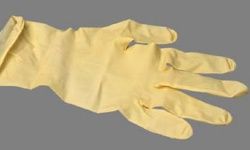
Avoid the culprits. If you do a lot of housework, it's exposure to detergents and cleansers; if you're a janitor, strong cleaning fluids; a bartender, citrus fruits; and so on. If you can't stay away from these substances, wear gloves whenever possible. Otherwise, you risk brittle nails and even nail separation or infection, which could lead to nail deformity or even loss of the nail.

Keep your nails short. The shorter your nails, the less the risk of damaging them.

Ways To Protect Your Toenails, Too
Toenails are most likely to fall prey to fungal infections. That's because the fungus that causes athlete's foot can invade the toenail after it's been injured.

Topical antifungals containing clotrimazole or miconazole will help defeat athlete's foot; apply them at the first sign of athlete's foot, hopefully before the fungus can invade the nail.

If the toenail does get infected, a prescription medication may be necessary to cure it.
Be careful of nail bangers. Don't use your nail
in place of a screwdriver, a scraper, or other tool. Try not to hit it with a hammer or slam it in drawers. You get the idea. Such actions can injure your nails, opening the door to infection, stopping nail growth, or causing bruises. See your doctor as soon as possible if a nail turns black and blue; if your physician isn
't available, go to an emergency room. The pressure should be relieved on the blood vessel that's been injured underneath the nail.

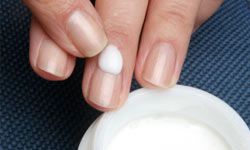
Moisturize your nails. Your nails contain no fat, so they can't naturally hold in moisture. Instead, try soaking them in tepid water, then applying a moisturizer, which will help lock in the water.
You may also want to try products that contain phospholipids, urea, or lactic acid -- all are "humectants." Complex 15, Aquaderm, and Moisturel are worth trying, or you may want to use an old standby -- petroleum jelly. Don't forget to reapply moisturizer after wetting or washing your hands or bathing.

Avoid moisture. Sounds like a contradiction, right? If your nail becomes infected, particularly with a yeast organism, it's important to avoid prolonged exposure to water and to keep the nail area as dry as possible, since infecting organisms generally prefer warm, moist environments.

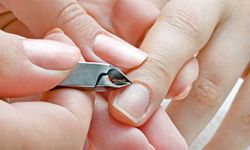
Care for your cuticles. But don't cut them with a mechanical instrument, which breaks down the cuticle's natural protection from bacteria and moisture. Avoid using so-called orange sticks, too. Instead, soak cuticles, then gently push them back with a moist towel.

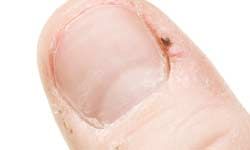
Don't pick or tear at hangnails. Otherwise, you're opening the door to infection by making a break in the skin where bacteria can enter. Clip the dry part of the hangnail with fine scissors, and apply an over-the-counter antibiotic ointment. Keeping your hands, nails, and cuticles moisturized will help prevent future hangnails.

Realize the risk with nail cosmetics. Sculptured nails can hold in too much moisture. The glues used in nail wraps can cause reactions resulting in permanent damage to the nail bed and root. The most common problem is separation of the nail from the bed. But if you notice any pain or tenderness, you're probably reacting to the glue, and you need medical attention.

Forget formaldehyde. Although most fingernail polishes and nail hardeners are not supposed to contain formaldehyde, some still do. And if they cause an allergy or irritation, you can end up with nail separation.

Cut down on polish remover. Nail polish remover contains acetone, which dries nails. Use these powerful solvents no more than once a week. The less, the better.

Don't eat gelatin hoping to build strong nails. It just doesn't work.

Ditto for calcium. It helps build bones but has little or nothing to do with the hardness of your nails. Unless you are crash dieting or suffering from a malabsorption problem, your nails are not influenced that much by your diet.

Let's discuss natural home remedies for nail problems in the next section.

For more information about nail, skin, and foot problems, try the following links:
This information is solely for informational purposes. IT IS NOT INTENDED TO PROVIDE MEDICAL ADVICE. Neither the Editors of Consumer Guide (R), Publications International, Ltd., the author nor publisher take responsibility for any possible consequences from any treatment, procedure, exercise, dietary modification, action or application of medication which results from reading or following the information contained in this information. The publication of this information does not constitute the practice of medicine, and this information does not replace the advice of your physician or other health care provider. Before undertaking any course of treatment, the reader must seek the advice of their physician or other health care provider.
Symptom Checker
Learn more about what ails you. Here are some common symptoms.
Common Symptoms:
Diseases A-Z
A comprehensive guide with three thousand articles, including images and multimedia.
Common Conditions: