
Manners of Death
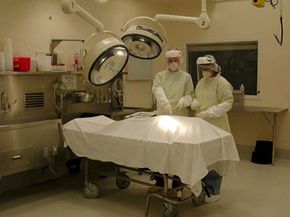
In death investigations, autopsies are most often performed by a forensic pathologist. A pathologist studies the effects of diseases, medical treatments and injury on the human body. A forensic pathologist specializes in using these studies to establish a legally admissible manner of death in a court of law.
There are four legally defined manners of death:
Advertisement
- Natural
- Accident
- Homicide
- Suicide [source: Waters, et al.]
After careful examination of all the evidence at hand, the forensic pathologist acting as a medical examiner or coroner (more on the distinction later) will assign a cause of death as one of these four manners.
For example, if the autopsy reveals a natural disease process such as leukemia or cancer, then the death would be considered natural.
The answers are not always that clear. The pathologist must consider all of the information. Severe head injuries that result in death with no evidence of assault could be hard to explain. But when that evidence is added to the police report that states the body was found next to an ice-covered, fallen ladder, the manner of death is an accident.
It would be easy to assume a gunshot wound is the result of a homicide. But an autopsy could reveal that the wound patterns, angle of bullet entry and gun powder residue indicate that the gun was fired while being held by the victim. The wounds are self-inflicted, so that would be ruled a suicide.
Sometimes, assigning a manner of death can get really complicated. "Let's say, somebody 30 years ago received a gunshot wound to the head and they developed a seizure disorder," Kiesel explains. "It's 30 years later, and they die from the seizure disorder. Well, the seizure disorder was caused by the gunshot wound; the gunshot wound is an unnatural event. That case would actually be classified as a homicide ... there's no time limit to that trauma. There's a time limit if you wanted to take it to court and sue somebody, but there's not a time limit as far as our making the call."
In the next section, we'll look at the difference between a coroner and a medical examiner.