
Higher Brains
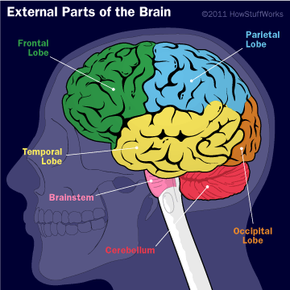
The cerebrum is the largest part of the human brain. It contains all of the centers that receive and interpret sensory information, initiate movement, analyze information, reason and experience emotions. The centers for these tasks are located in different parts of the cerebral cortex, which is the outside layer of the cerebellum and is comprised of gray matter. The inside is made up of white matter.
Major Parts of the Cerebral Cortex
Advertisement
The cortex dominates the exterior surface of the brain. The surface area of the brain is about 233 to 465 square inches (1,500 to 2,000 cm2), which is about the size of one to two pages of a newspaper. To fit this surface area within the skull, the cortex is folded, forming folds (gyri) and grooves (sulci). Several large sulci divide the cerebral cortex into various lobes: the frontal lobe, parietal lobe, occipital lobe and temporal lobe. Each lobe has a different function.
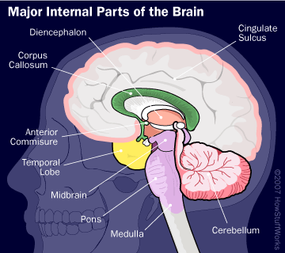
When viewed from above, a large groove (interhemispheric fissure) separates the brain into left and right halves. The halves talk to each other through a tract of white-matter fibers called the corpus callosum. Also, the right and left temporal lobes communicate through another tract of fibers near the rear of the brain called the anterior commissure.
If you look at a cutaway view of the brain, you see that the cortical area above the corpus callosum is divided by a groove. This groove is called the cingulate sulcus. The area between that groove and the corpus callosum is called the cingulate gyrus, also referred to as the limbic system or limbic lobe. Deep within the cerebrum are the basal ganglia, amygdala and hippocampus.
This ends our tour of the major structures of the cortex. Now, let's see what those structures do.