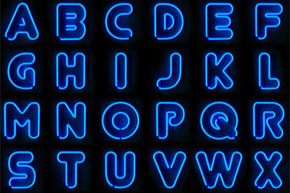
By the end of this article, you will probably think you have synesthesia in some form. At the very least, you will probably hope you do.
Synesthesia is a phenomenon where experiencing one sense (or cognitive pathway) results in the experience of another one. So you might "see" the letter B (typically uppercase and lowercase) as red or hear a word that makes you taste a certain flavor [source: Ramachandran and Hubbard]. Music, too, might be perceived as colorful, where a C note is maroon and F sharp is yellow -- it might change by octaves, too. Or maybe you see dates spatially -- Tuesday is always a yard or two to your right, a fixed position in space.
Advertisement
So have you found yourself already racking your brain, trying to decide if 8 is purple or the letter Q tastes like bananas?
If you really strongly understand any of these sensations, you might just be a synesthete. (Or synesthesiac, a term that doesn't exist but I think should.) And although for a long time, researchers thought synesthesia was incredibly rare, it turns out that just asking someone if they experience these symptoms isn't entirely accurate. A 2006 study that gave objective tests to subjects found that synesthesia was 88 times more likely than previously thought, and it affected 2-4 percent of the general population [source: Simner et al.].
Not every synesthete experience is the same, either in people or between different synesthetic forms. For example, a small 2005 study found that while grapheme-color synesthetes (those who perceive letters, numbers or words as colors) almost always associate a word with a color, many lexical-gustatory synesthetes (those who link words with a certain taste) don't have a particular association with every word [source: Ward et al.].
Advertisement