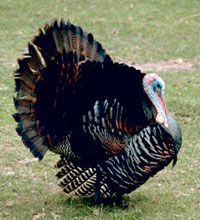
According to the Centers for Disease Control and Prevention, about 36,000 people die from the flu each year. [ref]. A new threat is the avian, or bird flu. The latest outbreak has infected more than 140 people in Asia and Europe. In February 2006, it migrated into Africa. [ref]. Health experts fear that it could eventually mutate into a form that could pass from person to person and set off a worldwide pandemic.
Unfortunately, there is no cure for either the flu or bird flu. A virus causes the flu, and antibiotics can only kill bacteria. There is a vaccine for the A and B strains of the human flu, but even that isn't a guarantee: sometimes the scientists who develop it get the strain wrong for a particular flu season. The current vaccine doesn't work against bird flu strains.
Advertisement
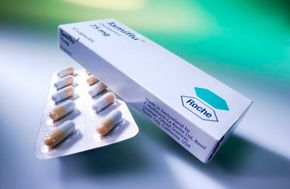
There are, however, a few antiviral prescription drugs that can lessen the severity and cut the duration of the flu as well as prevent infection if you've been exposed. Tamiflu is one of the most commonly prescribed drugs. In this article, we'll discuss how Tamiflu works, how you take it and whether it can really protect you from bird flu.
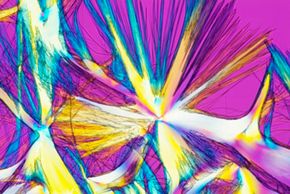
Crystalization of oseltamivir phosphate,the active ingredient in Tamiflu
Photo courtesy Roche
Tamiflu (oseltamivir phosphate) is an antiviral drug marketed by the Swiss pharmaceutical company Roche. It belongs to a group of drugs called neuraminidase inhibitors and can shorten the duration and lessen the severity of the type A and B strains of the flu, as well as bird flu.
Each 75-milligram capsule contains the active chemical oseltamivir, as well as several inactive ingredients. Scientists synthesize oseltamivir from shikimic acid, a naturally occurring substance found in plants like Chinese star anise, ginkgo, spruce, pine and fir trees.
Advertisement
Roche primarily obtains shikimic acid from the Chinese star anise, a spice found in the star-shaped fruit of the Illicium verum, a small evergreen tree. Roche uses a specific type of anise that grows in four mountain provinces (Guanxi, Sichuan, Yunnan and Guizhou) of southwest China. Because these regions are high altitude and have a hot, humid, climate, they produce a higher purity and greater yield of star anise than other regions.
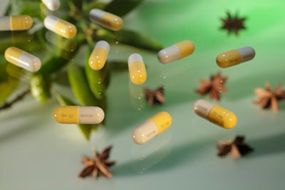
Tamiflu capsules with star anise fruit and pods
Photo courtesy Roche
The manufacture of Tamiflu involves a complex, 10-step process that takes approximately 6-8 months to complete. First, a Roche supplier extracts shikimic acid from the pods (the part that wraps around the seeds) of the star anise. The remaining steps involve a series of complex chemical reactions. Thirty kilograms (66 pounds) of star anise produces only 1 kilogram (just over 2 pounds) of shikimic acid.
Although most shikimic acid comes from star anise, Roche and its partners are increasingly using fermentation to produce it. Roche uses a special strain of the E. Coli bacteria in its fermentation process. When these bacteria are overfed glucose, or sugar, they produce shikimic acid. This process could produce greater yields of shikimic acid, and scientists are working to improve the fermentation process so they can use it more readily.
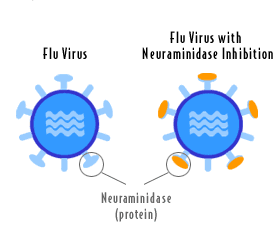
Tamiflu targets a protein called neuraminidase that lives on the flu virus cells. This protein helps the flu virus break through the cell walls so it can move on to other cells and replicate itself. Tamiflu inhibits the neuraminidase protein, so that the virus can't leave the cell to infect other cells. Eventually, the virus dies.
Photo courtesy Roche
Tamiflu can't stop the flu entirely. However, studies have shown that if you take it within 48 hours of showing symptoms, it can shorten the duration of the flu (strains A and B). Patients with the flu who took it felt better 30 percent (or 1.3 days) faster than people who didn't take it [ref]. The drug also can help protect you from getting the flu if you're exposed to someone who has it. But Tamiflu can't prevent the spread of the disease, and it won't stop illnesses (like the common cold) that resemble the flu.
Tamiflu isn't cheap, either. A 10-dose course can cost $60 to $80 in the United States. Currently there is no generic version of the drug available in the U.S.
Between 2004 and 2005, 12 children in Japan reportedly died after taking Tamiflu. However, the children also had neurological problems that could have been associated with the flu itself. In November 2005, the Pediatric Advisory Committee of the FDA ruled that the drug was safe for children [ref].
We'll find out how Tamiflu stands up to bird flu in the next section.
Taking Tamiflu
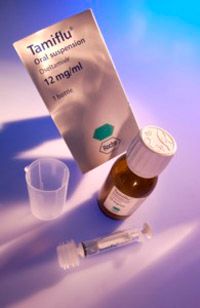
Tamiflu is available by prescription only, in both pill and liquid form. Each pill contains 75 milligrams of the drug, and the liquid (intended for children or adults who can't swallow pills) is a 12 milligram/milliliter suspension. For the drug to work, you must start taking it within a day or two of your first symptoms. Then you take Tamiflu twice a day for five days. Doctors recommend that you take all 10 doses, even if you start to feel better before you're finished.
Tamiflu is generally safe for adults and children ages one and up. The most common side effects are nausea and vomiting, but you can help prevent them by taking the drug with food. Other, less common side effects are bronchitis, insomnia, skin rashes and vertigo.
People who are allergic to oseltamivir phosphate, or any of Tamiflu's other ingredients shouldn't take it. It's also not recommended for women who are pregnant or nursing. You should tell your doctor if you are on any other medication, or if you have kidney or heart problems.
Advertisement
Tamiflu vs. Bird Flu
Viruses that normally occur in birds cause bird flu, and there are many different strains. Some of these viruses can pass from birds to other animals, and most of them are mild. However, there have been several human outbreaks of the H5N1 strain of bird flu in Asia and Europe over the last decade. Scientists are concerned that this strain will eventually mutate into a form that can pass directly from human to human. When the H5N1 strain re-emerged in Asia during the winter of 2003, it set off fears of a worldwide pandemic. (See How Bird Flu Works for more information.)
The flu vaccine that works against the A and B "regular flu" strains is not effective against bird flu. Although scientists are hard at work developing an avian flu vaccine, currently antiviral drugs are the only weapon against the disease.
Advertisement
Laboratory studies show that Tamiflu is effective against several strains of bird flu, including H5N1. It works the same way that it works against the "regular flu." However, it only lessens the severity of the illness -- it can't stop the virus entirely. The World Health Organization recommends Tamiflu as the drug of choice should an avian flu pandemic occur. Doctors in Asia are already using Tamiflu to treat patients who have become ill with the H5N1 strain.
Fake Flu Drug
The overwhelming demand for Tamiflu has led to a booming counterfeit business. Customs agents have seized hundreds of packages of fake Tamiflu trying to make its way into the United States from as far away as Asia and the island of Mauritius. The fake pills have contained little, if any, of the drug's active ingredient.
Health experts fear that people will order Tamiflu from suspect sources and mistakenly think that it will protect them during a pandemic. The only way to make sure that you're getting the real thing is to get a prescription from your doctor and fill it at a reputable pharmacy.
Stockpiling Tamiflu
Photo courtesy Roche
The problem with any antiviral drug is that the virus can develop resistance to it. Doctors are concerned that the flu could become resistant to Tamiflu, just as the influenza A strain has become resistant to the antiviral drugs Symmetrel (amantadine) and Flumadine (rimantadine).
Some flu strains have already shown resistance to Tamiflu, including those found in a few patients with the avian flu. Health officials are concerned that during a pandemic, when infection persists for a longer period, the risk for resistance could be even higher.
Advertisement
In 2005, Roche donated 3 million treatment courses (30 million capsules) of Tamiflu to the World Health Organization to create an international stockpile. The company donated an additional 2 million courses (20 million capsules) to the WHO in January 2006.
Because Roche is the sole patent owner, the company has had a difficult time producing enough to go around. This is partially due to the difficulty in isolating shikimic acid from star anise in large quantities. Roche continues to increase its manufacturing capability. It claims that by 2007, it will be able to produce over 300 million treatments of Tamiflu annually, more than ten times the production in 2004.
Some countries said they would ignore the patent and manufacture generic versions of the drug, while others said they would license their own version from Roche to protect people in the event of a pandemic. In 2005, Roche granted Vietnam permission to produce a generic version of the drug. That same year, the Indian drug company Cipla announced that it would defy Roche's patent and make its own generic version of the drug without a license. Recently, Roche granted sublicenses to manufacture Tamiflu to a Chinese and an Indian drug company [ref].
With fears rising about a potential bird flu pandemic, it's not surprising that many Americans are thinking about keeping their own supply of the antiviral drug. But is it a good idea? Many health experts warn against the practice, saying that it's often difficult to know whether you have the flu or just a garden-variety cold, and taking Tamiflu too often could lead to the development of drug-resistant virus strains. The World Health Organization has recommended that governments stockpile antiviral medications in advance of a pandemic to ensure that sufficient supplies are available.
To learn more about Tamiflu, the flu and bird flu, check out the links in the next section.
The History of Tamiflu
Tamiflu was the first orally active neuraminidase inhibitor developed commercially. Gilead Sciences developed the drug, but Roche marketed it under its current trade name. In 1999, the FDA approved Tamiflu for the treatment of the flu in people ages one and older, and for the prevention of the flu in adolescents and adults.
At first, the drug's sales were unimpressive. However, fears of an avian flu pandemic and the subsequent international stockpile of Tamiflu led to a spike in Roche's profits. The company went from $76 million in sales of the drug in 2001 to $700 million in 2005.
"Customs Agents Seize Counterfeit Tamiflu."AP Press on MSNBC.com, December 18, 2005. http://www.msnbc.msn.com/id/10523190/
Elias, Paul. "Roche Promises New Plant for Bird Flu Drug." Boston.com, October 18, 2005. http://www.boston.com/yourlife/health/diseases/articles/2005/10/18/eu_nations_declare_bird_flu_global_threat/
"FDA Approves Tamiflu for Influenza." WebMD, November 19, 2005. http://www.fda.gov/bbs/topics/ANSWERS/ANS00982.html
Flores, Graciela. "Getting Around Flu Drug Shortage." The Scientist, January 4, 2006. http://www.the-scientist.com/news/display/22917/
Hitti, Miranda. "FDA: Tamiflu Safe for Kids." http://www.webmd.com/content/Article/115/111807.htm
How the Flu Works https://health.howstuffworks.com/flu.htm
Jefferson, T, et al. "Antivirals for influenza in healthy adults: systematic review." The Lancet Online, January 19, 2006. http://www.thelancet.com/journals/lancet/article/PIIS0140673606679701/fulltext
Key Facts About Avian Influenza, CDC, February 7, 2006. http://www.cdc.gov/flu/avian/gen-info/facts.htm
Key Facts About Influenza, CDC, September 28, 2005. http://www.cdc.gov/flu/keyfacts.htm
Osterweil, Neil. "Save Newer Flu Drugs for Pandemic, Researchers Advise." Med Page Today, January 18, 2006. http://www.medpagetoday.com/InfectiousDisease/URItheFlu/dh/2511
Roche - About Us http://www.rocheusa.com/about/history.html
"Roche Donates Bird Flu Drug to WHO Reserve." Daily News Central, August 24, 2005. http://health.dailynewscentral.com/content/view/1555/0
"Roche Donates Tamiflu Stockpile for Poor Countries." http://today.reuters.co.uk/news/newsArticle.aspx?type= globalNews&storyID=2006-01-17T073114Z_01_PEK145289_RTRUKOC_0_US-B IRDFLU-CHINA-TAMIFLU.xml
"Roche Steps up Tamiflu Production but Keeps Tight Grip on Patent Rights." Daily News Central, October 19, 2005. http://health.dailynewscentral.com/content/view/0001793/58/
Son, Minh. "VN successfully extracts shikimic acid from star aniseed." Vietnam.net, October 1, 2006. http://english.vietnamnet.vn/tech/2006/01/530959/
Tamiflu http://www.tamiflu.com/
"Tamiflu Works Against Avian H5N1 Strain." Medical News Today, November 1, 2004. http://www.medicalnewstoday.com/medicalnews.php?newsid=15740
Walton, Marsha. "O Tamiflu: Turning Christmas Trees into Flu Drug." CNN, January 20, 2006. http://edition.cnn.com/2006/HEALTH/conditions/01/20/tamiflu.xmas.trees/
Cite This!
Please copy/paste the following text to properly cite this HowStuffWorks.com article: