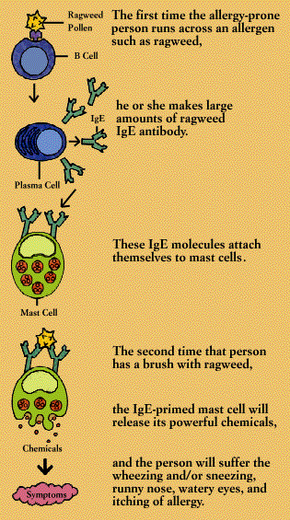
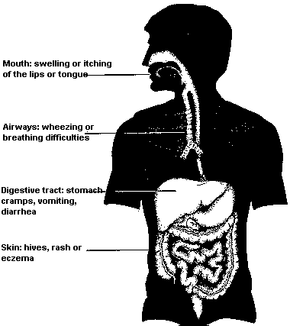
The list of possible allergens may be limited only by the number of protein molecules in existence. However, some do turn up more than others. Many people suffer from seasonal, respiratory allergies, usually in the spring or fall and caused by pollen, mold and dust. Some people suffer from food allergies. Common allergenic foods are peanuts and shellfish. Of injected allergens, penicillin and insect venom are common offenders.
Allergists use a variety of diagnostic techniques to determine if a person is allergic. Unfortunately, the safest and often the most effective tests are not completely reliable by themselves in identifying if a substance is the cause of a patient's symptoms.
The most common test, the scratch test, consists of applying a diluted extract of the possible allergen to the back or arm, and then scratching the skin with a needle. If the patient develops a certain degree of swelling or redness in the scratched area, the existence of IgE antibodies to that allergen is indicated. Blood tests are another avenue of diagnostics, especially in small children. With small children, the scratch test is used less often because the possible allergens used in the test may actually trigger a reaction in a child who has not been exposed to that substance before. Neither the scratch test nor the blood test is 100 percent accurate, but the results, taken together with a patient's medical history, can help the doctor or allergist with a diagnosis and treatment plan.
There are three techniques commonly offered by doctors to help allergy sufferers:
- Avoidance
- Medication
- Immunotherapy
Many allergens, once identified, can simply be avoided. If you know you're allergic to shellfish, you don't eat it. Pet allergies can be handled sometimes by keeping the pet outside.
Unfortunately, many allergens -- like pollen, mold and dust -- are very difficult, if not impossible, to avoid. These can often be managed by using medications such as antihistamines, decongestants, cromolyn sodium, corticosteroids and, in the case of anaphylaxis, epinephrine.
Immunotherapy is expensive, time consuming and not without risk. But it is often the only hope a person has for leading a normal life. It consists of a series of injections of the offending allergen, beginning with a very weak dilution and gradually building in strength to a maintenance dose that may be continued over time. The injections help the immune system to produce fewer IgE antibodies, while also stimulating the production of a blocking antibody called IgG. This works to varying degrees with many allergies, but some cannot be treated this way.
As with all medical discomforts and problems, you should seek the advice of your doctor or allergist if you suspect you are allergic to something.
For more information on allergies and related topics, check out the links on the next page.