About Benign Prostatic Hyperplasia
This condition is commonly referred to as an enlarged prostate gland. Typically occurring in half of men over the age of 50 in the United States, an enlarged prostate gland sometimes makes urination difficult.
BPH may be accompanied by frequent urges to urinate and sometimes by partial incontinence. It is not predictive of prostate cancer, but its presence is still disturbing, and it should be monitored by a health care professional who can determine whether it is a benign condition or cancer.
Herbal Remedies for Benign Prostatic Hyperplasia
The healing garden offers several remedies for BPH. Tea, tincture, or capsules of hydrangea root or horsetail are often used to reduce the inflammation of the prostate gland. Nettle root tincture or capsules are also helpful. In fact, scientific studies have proved its ability to diminish this enlarged gland. Amounts used in successful studies range from 6-12 mL of tincture per day in divided doses, or 120 mg capsules twice a day.
Saw palmetto, a very beneficial and well-studied herb, provides great therapy for the enlarged prostate. In fact, one study showed significant improvement in 45 days with only mild or no side effects. However, saw palmetto is a wild palm tree that grows in swamps of the southeastern United States -- so it's not likely to be in your garden or landscape. For best results, you may wish to use a combination of all the herbs mentioned. Since excessive consumption of animal products increases the risk of BPH, eating more vegetables and fruits of all kinds is likely to be beneficial.
A hormone imbalance is usually the cause of an enlarged prostate. Although the body normally turns ordinary testosterone into a very potent form called dihydrotestosterone (DHT), it can cause an enlargement when there is too much DHT. Wrapping around the urethra, the tube that allows urine to exit the bladder, a swollen prostate gland acts like a clamp, sometimes resulting in problems with urination. Men may need to get up several times a night to urinate or have the sensation of a full bladder even after urinating. Frequent urges result only in dribbling urination that has little force. If the urethra is too impaired, urine may back up throughout the urinary system. This significantly increases the risk of a urinary tract infection and/or kidney damage.
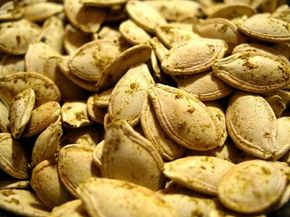
![]() ©2007 Blue Lotus Pumpkin seeds are rich in the essential minerals zinc and copper. |
An enlarged prostate gland should be diagnosed only by a health care practitioner to rule out prostate cancer. Get a thorough lab workup to ensure you are dealing only with an enlarged prostate. If you have Wilson disease, you should not use copper supplements.
For more information about the subjects covered in this article, try the following links:
- To see all of our herbal remedies, visit our main Herbal Remedies page.
- To learn more about treating common medical conditions yourself, go to our main Home Remedies page.
- To learn other ways you can treat the symptoms of prostate problems at home, read Home Remedies for Prostate Problems.
- To find out more about saw palmetto and how it improve men's health, read Saw Palmetto: Herbal Remedies.
Gayle Povis Alleman, M.S., R.D. hold degrees in both alternative and conventional nutrition. She manages nutrition education programs and teaches nutrition in the community. She is also a freelance writer and speaker in the area of food, nutrition and health, specializing in holistic nutrition to promote optimum health.
ABOUT THE CONSULTANTS
Silena Heron was a naturopathic physician with a family health-care practice. She was a nationally recognized specialist in botanical medicine who had taught throughout the West and Canada since 1973. She was founding chair of botanical medicine at Bastyr University and on the faculty for six years. Additionally, Dr. Heron was an adjunct faculty member at Southwest College of Naturopathic Medicine. She was the founding vice president of the Botanical Medicine Academy, an accrediting organization for the clinical use of herbal medicines.
Eric Yarnell, N.D., R.H. (A.H.G.) is a naturopathic physician and registered herbalist in private practice specializing in men's health and urology. He is an assistant professor in the botanical medicine department at Bastyr University in Seattle and is president or the Botanical Medicine Academy. He is the author of several textbooks including Naturopathic Gastroenterology, Naturopathic Urology and Men's Health, and Clinical Botanical Medicine; He writes a regular column on herbal medicine for Alternative and Complementary Therapies.
This information is solely for informational purposes. IT IS NOT INTENDED TO PROVIDE MEDICAL ADVICE. Neither the Editors of Consumer Guide (R), Publications International, Ltd., the author nor publisher take responsibility for any possible consequences from any treatment, procedure, exercise, dietary modification, action or application of medication which results from reading or following the information contained in this information. The publication of this information does not constitute the practice of medicine, and this information does not replace the advice of your physician or other health care provider. Before undertaking any course of treatment, the reader must seek the advice of their physician or other health care provider.
Before engaging in any complementary medical technique, including the use of natural or herbal remedies, you should be aware that many of these techniques have not been evaluated in scientific studies. Use of these remedies in connection with over the counter or prescription medications can cause severe adverse reactions. Often, only limited information is available about their safety and effectiveness. Each state and each discipline has its own rules about whether practitioners are required to be professionally licensed. If you plan to visit a practitioner, it is recommended that you choose one who is licensed by a recognized national organization and who abides by the organization's standards. It is always best to speak with your primary health care provider before starting any new therapeutic technique.