
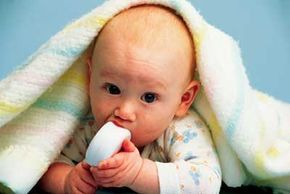
Just when you thought your bouncing bundle had started sleeping through the night, she decides to wake up the neighborhood with a 3 A.M. concert. You wander, bleary-eyed, into her room, wondering what in the world is the matter. You pick her up and hold her for a bit. As soon as you sit in your trusty rocker, your little miss sticks your finger in her mouth and starts gnawing. She's been doing this for a few months, but tonight you feel something firm and hard protruding out of her bottom gums. Her first tooth!
Your baby's first tooth is certainly a time for rejoicing. It's a real milestone in her life. And it also explains why your kid has been a drool factory, why she's been sticking anything and everything into her mouth lately, and why she's been so cranky. By the time that first tooth cuts through the gums, your baby has endured swollen, painful, inflamed gums for days or even months. They don't call it "cutting" teeth for nothing. Getting those first teeth is an ordeal for any kid.
Advertisement
In this article, we'll offer 17 ways to ease the pain of teething, from home remedies using things found in your kitchen to tips about how to make your baby more comfortable. But first: What is teething, exactly?
Babies actually have tooth buds in place, resting right under the gums, before they're born. The primary teeth, which form before the baby is born, usually begin surfacing around six or seven months of age with a single lower central incisor. But, like many things in nature, there is a wide range of "normal" when it comes to the timing of tooth eruption. Don't be surprised, then, if a baby starts sprouting choppers at 2 months or doesn't begin teething until he or she is 12 months old.
In general, teeth begin to appear on the following schedule: the central incisors, the teeth right in the middle of the jaw on the top and bottom, come in at 6 to 12 months; lateral incisors at 9 to 13 months; canine (cuspids) at 16 to 22 months; the first molars at 13 to 19 months; and the second molars at 25 to 33 months. Most children have all of their primary teeth by age three.
The process of teething, or "cutting" all of these baby teeth, can be painful for both the baby and the caregivers. When a tooth pushes through the sensitive gum mucosa, it hurts, and the baby is likely to become cranky and fussy.
The process of getting primary teeth continues until close to the third birthday. Your sweet pea will probably get her bottom front teeth first, followed by her top front teeth. Don't fret if she has huge gaps between teeth or if the teeth grow in a little crooked. Things will straighten out over time.
By the time your little one is finished getting that first set of teeth, she'll have 20 munching, crunching teeth. These will stay in place until she's ready for permanent teeth, sometime around her sixth birthday.
Teething symptoms often include crankiness, drooling, chewing, crying, gum redness, decreased appetite, and difficulty sleeping. In addition, some babies spit up and have mild diarrhea due to gastrointestinal reactions to changes in the character and amount of their own saliva. Other babies develop a red and slightly swollen rash on the cheeks, chin, neck, and chest from the saliva's contact with the skin. Sometimes, teething causes babies to develop a mild fever, congestion, and ear pulling that often mimics middle ear infection. All of these symptoms are normal. (But of course, if you are worried, you can always call your pediatrician's office just to put your mind at ease.)
Teething is, of course, just a part of life. But there are some things you can grab in the kitchen that will ease your baby's discomfort and make her a happy camper -- at least for a while. In the next section, we'll discuss home remedies for calming teething pain.
For more information about taking care of babies, visit the following sections:
- To see all of our home remedies and the conditions they treat, go to our main Home Remedies page.
- For tips on new baby care, read our How to Care for a Newborn section.
- New moms don't always have it easy. If you're wondering why this kid didn't come with an instruction manual, check out How to Adjust to a Newborn.
- Feeling a little tender? Read our Home Remedies for Breast-Feeding Discomfort section.
This information is solely for informational purposes. IT IS NOT INTENDED TO PROVIDE MEDICAL ADVICE. Neither the Editors of Consumer Guide (R), Publications International, Ltd., the author nor publisher take responsibility for any possible consequences from any treatment, procedure, exercise, dietary modification, action or application of medication which results from reading or following the information contained in this information. The publication of this information does not constitute the practice of medicine, and this information does not replace the advice of your physician or other health care provider. Before undertaking any course of treatment, the reader must seek the advice of their physician or other health care provider.