
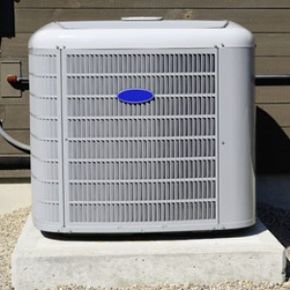
Your home's comfort systems (air conditioning and heating) can help or hinder your allergen-control efforts. This article will show you how to evaluate these systems and make them as efficient and hypoallergenic as possible.
Check Humidity
Ridding the house of excess moisture helps prevent the spread of mold and decreases the survival rate of dust mites and cockroaches. If you live in an area of high humidity, you might want to invest in a humidity gauge (available at most hardware stores). Humidity in your house should range around 40 percent. Humidity above 50 percent is considered a resort for the dust mites and molds, while a reading below 20 percent might be called the Sahara Desert. Be sure to check humidity readings throughout the house and not just in one room.
Advertisement
If humidity readings hover near the steam-bath level, you can lower moisture in the air with an air conditioner and dehumidifier.
Air-conditioning (AC)
If you've ever had the windows fog up while you're driving, you know that the best way to remove the moisture is to turn on the air conditioning (AC). The same method applies to the house, but only in warm weather. (Who is going to blast cold air when it's snowing outside?) Despite this weather-sensitive requirement, air conditioning does more than dehumidify the air; it filters out pollen and helps discourage cockroaches, which dislike the airflow. Dust mites and mold, too, hate the cool, dry air.
To maintain the benefits of AC, your unit needs cleaning and regular maintenance. Whether you've got central AC or window or wall-mounted units, the filters must be cleaned frequently both for efficiency and to prevent mold growth. Some models can be equipped with electrostatic filters, which rely on static charges created when air passes through the filters, to help capture certain allergens.
Electrostatic filters must be cleaned regularly to maintain their efficiency. If electrostatic filters are unavailable, use regular, or pleated, air-conditioning filters, which work just as well as electrostatic filters in removing 95 percent of all allergens.
To eliminate mold growth in air conditioning ducts, try running the unit for 30 minutes after turning off the cooling to help dry out ducts. Lastly, if you have a recycle switch on your AC, be sure to use it because it recirculates air inside the house. Pollen-allergy sufferers work against their own interest if they continually allow outside air to be pulled inside.
Dehumidifiers
These devices work by cooling the air so that excess humidity condenses into a bucket, which can be emptied. Oftentimes, the heat generated by a dehumidifier can be too much in the summer and is used in conjunction with the air conditioning.
Like its cooler cousin, the air conditioner, dehumidifiers must be cleaned regularly or else mold spores will happily take over.
Enclosed spaces, such as closets, can trap moisture. Dehumidifiers work well here, but for even smaller spaces, such as an armoire or a cabinet, try using a desiccant. These moisture-wicking agents come in several forms, including absorbing flakes and cartridges. Some cartridges can be recycled by drying them in a warm oven. Desiccants also make ideal moisture wickers for camera bags, shoe storage boxes, and other areas where molds and moisture hide. Just be sure to keep the packages or cartridges away from children and pets.
In the next section we will cover how to make sure your heating system is allergy-proof.
This information is solely for informational purposes. IT IS NOT INTENDED TO PROVIDE MEDICAL ADVICE. Neither the Editors of Consumer Guide (R), Publications International, Ltd., the author nor publisher take responsibility for any possible consequences from any treatment, procedure, exercise, dietary modification, action or application of medication which results from reading or following the information contained in this information. The publication of this information does not constitute the practice of medicine, and this information does not replace the advice of your physician or other health care provider. Before undertaking any course of treatment, the reader must seek the advice of their physician or other health care provider.
Advertisement