Introduction to How Sunburn and Sun Tans Work
![]() |
Does this make sense? What exactly is a sunscreen? And what is a tan? What is the difference between a tan and a burn? Why can you spread a little blob of lotion on yourself and be protected, but if you forget you are miserable?
If you take the time to look at skin and sunlight in some detail, all of this actually does begin to make sense. You can learn a huge amount about your body in the process. So, that's what we'll do in this article. First, let's take a look at how skin works.
Skin is one of the most amazing organs in the human body. It is hard for us to think about it as an organ, however. We tend to think of organs as boxy things. Your heart, liver, kidneys - those are obviously organs. But skin is an organ too, especially if you look at the dictionary definition of "organ", like this definition from the Merriam Webster Collegiate Dictionary:
-
Organ - a) differentiated structure (as a heart, kidney, leaf, or stem) consisting of cells and tissues
and performing some specific function in an organism b) bodily parts performing a function or cooperating in an activity
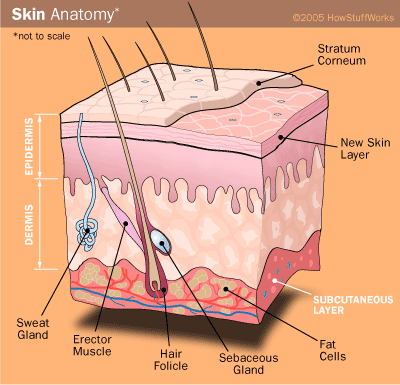
If you take a look at a cross section of typical skin (like the skin on your arm or leg) you find that it is made up of two main layers: the epidermis on the outside and the dermis on the inside. The epidermis is the barrier, while the dermis is the layer containing all the "equipment" -- things like nerve endings, sweat glands, hair follicles and so on. Here's a picture to help you see what is going on:
![]() |
In the subcutaneous layer (you may have heard of subcutaneous fat -- this is where it lives) you can see the blood vessels (shown as two thin red and blue lines). These vessels branch infinitely (not shown) into the dermis to supply the sweat glands, hair follicles, sebaceous glands and erector muscles with blood. They also fan out into the dermis's capillary bed. It turns out that the dermis is loaded with capillaries. Capillaries satisfy the nutritional needs of the cells in the dermis, and they also help the skin perform an important cooling function in humans. The epidermis has no direct blood supply, but instead is supported and fed by the dermis.
The Dermis
The dermis is where the action is functionally. The dermis contains sweat glands, hair follicles (each with its own tiny little muscle so that your "hair can stand on end"!), nerve endings and so on. There are several different types of nerve endings:
- Heat sensitive
- Cold sensitive
- Pressure sensitive
- Itch sensitive
- Pain sensitive
The epidermis is your interface to the world, and it is actually quite interesting. It has two main layers, the inner of which is living and the outer of which is dead. The dead skin cells of the outer layer are what we can actually see, and they are constantly flaking off and being replaced by new cells being pushed outward.
The living, inner layer is called the malpighian layer. The malpighian layer creates the dead cells that we can see. It is in direct contact with the dermis, which feeds and supports it. The malpighian layer is our focus of attention actually, because it is here that the sun affects the skin during tanning. The malpighian layer is itself layered like this:
- In direct contact with the dermis is the basal layer. If you have ever heard of a basal cell carcinoma (cancer), this is where it starts.
- Above the basal layer is the spinous layer.
- Above the spinous layer is the granular layer.
Living among the basal cells in the malpighian layer is another type of cell called a melanocyte. Melanocytes produce melanin, which is a pigment that is the source of tanning. The melanocytes are actually where a tan comes from. Here is what the Encyclopedia Britannica has to say about melanocytes:
-
"The appearance of the skin is partly due
to the reddish pigment in the blood of the superficial vessels.
In the main, however, it is determined by melanin, a pigment manufactured by
dendritic cells called melanocytes, found among the basal cells of the epidermis.
Their numbers in any one region of the body, which range from
about 1,000 to more than 2,000 per square millimetre, are roughly
the same within and between races; the blondest whites have as many as the darkest
blacks. Colour differences are due solely to the amount of melanin
produced and the nature of the pigment granules. When the skin becomes tanned on
exposure to sunlight, the melanocytes do not increase in number, only in activity."
("Integumentary Systems, Pigmentation", Britannica CD. Version 97. Encyclopaedia Britannica, Inc., 1997.)
Tanning
So, now that we know all about the skin we can start to actually understand tans and sunburns. When you get a tan, what is actually happening is that the melanocytes are producing melanin pigment in reaction to ultraviolet light in sunlight. Ultraviolet light stimulates melanin production. The pigment has the effect of absorbing the UV radiation in sunlight, so it protects the cells from UV damage. Melanin production takes a fair amount of time -- that is why most people cannot get a tan in one day. You have to expose yourself to UV light for a short period of time to activate the melanocytes. They produce melanin over the course of hours. By repeating this process over 5 to 7 days pigment builds up in your cells to a level that is protective.The previous paragraph applies to Caucasians. In a variety of other races, melanin production is continuous, so the skin is always pigmented to some degree. In these races the incidence of skin cancer is much lower because cells are constantly protected from UV radiation by melanin.
Melanocytes actually produce two different pigments: eumelanin (brown) and phaeomelanin (yellow and red). Red heads happen to produce more phaeomelanin and less eumelanin, which is why they don't tan very well. In albinos, the chemical pathway that produces melanin cannot proceed because an enzyme called Tyrosinase is missing. Therefore albinos have no melanin in their skin, hair or irises.
Melanocyte-stimulating hormone (MSH) is produced by the pituitary gland. MSH flows through the bloodstream and reaches the melanocytes, encouraging them to produce more melanin (for example, a person injected with a large dose of MSH will get darker). The pituitary gland is actually quite interesting -- it is tied into the optic nerve, which means that it can sense light. If you have ever raised chickens for eggs, you know that in the winter egg production falls way off. You solve this problem by providing light in the chicken coop. The extra light stimulates the pituitary gland in chickens, which causes the gland to produce a hormone essential to egg laying. In humans, light affects the pituitary gland as well and one result is the production of MSH. A funny side-effect of all of this is that wearing sunglasses may make you more susceptible to sunburn! See this page for some thoughts on the subject.
One of the interesting things about UV radiation is that it is reflected by different surfaces. These reflections can amplify the effects of UV exposure. For example, snow reflects 90% of UV light. That is why you can get snow blindness and severe sunburns from skiing on a sunny day. Sand can reflect up to 20% of UVB that hits it, meaning that you can get extra UV exposure at the beach. On the other hand, certain things absorb almost all UV radiation partially or completely. Glass is one of these substances -- many glasses are very good absorbers of UV (which is why you may have heard that you cannot get sunburn in a greenhouse -- just make sure it is glass and not plastic covering the greenhouse!). Most sunscreens use chemicals that have the same UV-absorbing properties. |
Sunburn
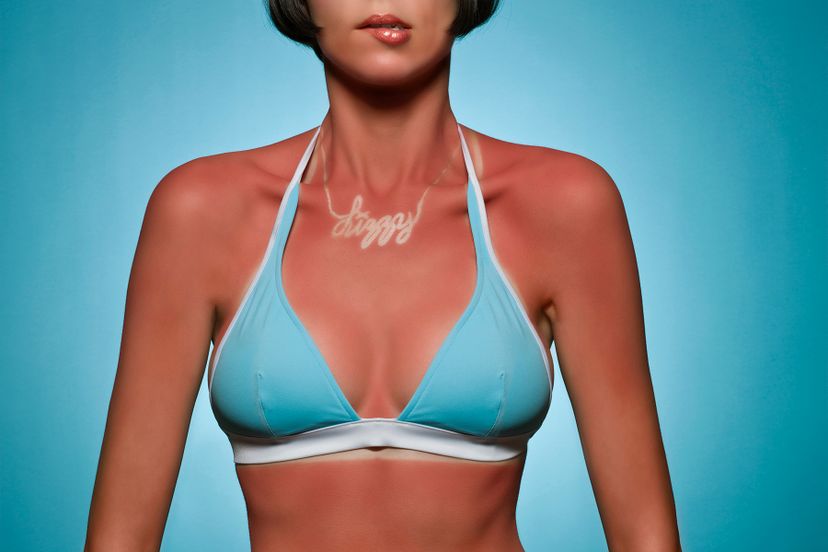
If you are Caucasian and you don't have a tan, then the cells in your skin are not protected from the sun's ultraviolet radiation. You are therefore an easy target for sunburn if you spend too much time in the sun. As anyone who has a sunburn knows, sunburn leaves your skin red and extremely painful. In severe cases the skin forms blisters.When you get sunburn, your skin is actually damaged by UV radiation and your body is responding to the damage. Here is a specific medical description of what is happening from this article:
- Sunburn is a popular term applied to the marked erythema and pain that commonly follows injudicious sun exposure. A sunburn is really a delayed ultraviolet B-induced erythema caused by an increase in blood flow to the affected skin that begins about 4 hours and peaks between 8-24 hours following exposure [23, 30, 31]. The underlying cause of this vascular reaction is direct and indirect damage to specific cellular targets from photochemical reactions and the generation of reactive oxygen species [32]. Damage to DNA, and the activation of several inflammatory pathways, particularly involving prostaglandins [27, 33-38], are thought to trigger this reaction, ultimately leading to vasodilation and edema. Biologic response modifiers released by both keratinocytes and lymphocytes also play a role [39-55]. The development of erythema therefore implies that enough ultraviolet damage has occurred that inflammatory pathways have been activated. Erythema is probably best thought of as a total failure of sun protection, and is a marker for severe UV damage.
Several lines of evidence suggest a relationship between erythema and DNA damage. There is rough correlation between pyrimidine dimer yield and susceptibility to erythema with sun exposure [56]. Wavelengths that are the most efficient at producing erythema are also the most efficient at producing pyrimidine dimers [56]. From a scientific point of view, a sunburn can be viewed as a marker for a substantial ultraviolet over-exposure that has clinical implications for skin cancer risk. It is now appreciated that there is a linkage between a history of repeated, severe sunburn and increased risk for melanoma [1, 57-62] and non-melanoma skin cancer [63-65].
Sunscreens
| Cod liver oil supplies Vitamin D, and it was commonly prescribed before the advent of Vitamin D fortified milk. The other way to get Vitamin D is to expose your skin to ultraviolet light. Ultraviolet light converts 7-dehydrocholesterol flowing in your bloodstream into Vitamin D. (See How Vitamin D Works for details.) |
- Cinnamates absorb UVB.
- Benzophenones absorb UVA.
- Anthranilates absorb UVA and UVB.
- Ecamsules absorb UVA.
The SPF rating, by the way, applies only to UVB radiation.
In July 2006, the FDA approved Mexoryl SX (ecamsule) for sale in the United States. Mexoryl SX has been sold by L'Oreal as Anthelios SX in Europe and Canada for more than 10 years, and it does a better job of blocking UVA rays than other sunscreens on the market. Dermatologists are calling it the best sunscreen in the world.
There is something about this whole discussion that is fascinating. On your body is an organ -- the skin -- and it responds in all of these interesting ways to sunlight.
For more information on sunburns, sun tans, sunscreens and related topics, check out the links on the following page.
Lots More Information
Related HowStuffWorks Articles
- How Light Works
- How the Sun Works
- How Vitamin D Works
- 29 Home Remedies for Sunburn
- How do sunless-tanning products work?
- What is a "sunburn"?
- Sunburn
More Great Links