Skin is one of the most amazing organs in the human body. It is hard for us to
think about it as an organ, however. We tend to think of organs as boxy things. Your
heart, liver, kidneys - those are obviously organs. But skin is an organ
too, especially if you look at the dictionary definition of "organ", like this
definition from the Merriam Webster Collegiate Dictionary:
Organ - a) differentiated structure (as a heart, kidney, leaf, or stem) consisting of cells and tissues
and performing some specific function in an organism b) bodily parts performing a function or cooperating in an activity
By that definition, skin is definitely an organ. Skin is made up of very specific cells and tissues, and
their collective purpose is to act as the boundary between "you" and "the world". One of the neat
things about skin that makes it different from a lot of other organs is the fact that it does have
to deal with the real world. Therefore it is loaded with sensors, and it also has a very tough
layered design so that it can handle realities of the environment like abrasion and sunlight.
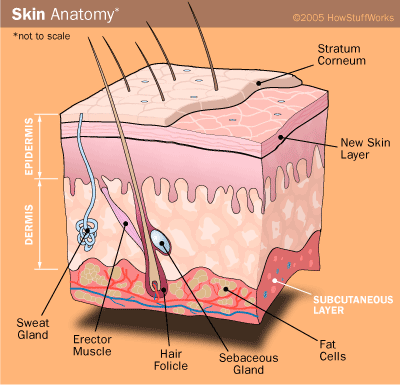
If you take a look at a cross section of typical skin (like the skin on your arm or leg) you find that
it is made up of two main layers: the epidermis on the outside and the dermis on the inside. The
epidermis is the barrier, while the dermis is the layer containing all the "equipment" -- things like nerve
endings, sweat glands, hair follicles and so on. To the right is a picture to help you see what is going on.
In the subcutaneous layer (you may have heard of subcutaneous fat --
this is where it lives) you can see the blood vessels (shown as two thin red and blue lines).
These vessels branch infinitely (not shown) into the
dermis to supply the sweat glands, hair follicles, sebaceous glands and erector muscles with blood. They
also fan out into the dermis's capillary bed.
It turns out that the dermis is loaded with capillaries. Capillaries satisfy
the nutritional
needs of the cells in the dermis, and they also help the skin perform an important cooling function in humans.
The epidermis has no direct blood supply, but instead is supported and fed
by the dermis.
Learn more about the dermis on the next page and how it relates to melanoma and sun exposure.
The dermis is where the action is functionally. The dermis contains sweat glands,
hair follicles (each with its own tiny little muscle so that your "hair can stand on end"!), nerve
endings and so on. There are several different types of nerve endings:
- Heat sensitive
- Cold sensitive
- Pressure sensitive
- Itch sensitive
- Pain sensitive
All these different nerve endings let you sense the world. They also help you protect yourself
from burns, punctures and the like by warning you when something is damaging your skin.
The epidermis is your interface to the world, and it is actually quite interesting. It has two main layers,
the inner of which is living and the outer of which is dead. The dead skin cells of the outer layer
are what we can actually see, and they are constantly flaking off and being replaced by new
cells being pushed outward.
Learn about the layers of skin on the next page.