Heart Benefits From Olive Oil
Studies have shown that a phytochemical in olive oil called hydroxytyrosol "thins" the blood. Other phytochemicals reduce inflammation of the blood vessels, prevent oxidation of fats in the bloodstream, protect blood vessel walls, and dilate the blood vessels for improved circulation.
Cholesterol Combatant
Olive oil boosts heart health by keeping a lid on cholesterol levels. It lowers total cholesterol, LDL cholesterol, and triglyceride levels. Some studies show that it does not affect HDL cholesterol; others show that it slightly increases HDL levels.
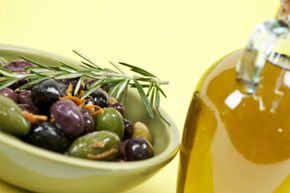
![]() ©2007 Publications International, Ltd. Many studies have demonstrated that olive oil fights bad cholesterol. |
The polyphenolic compounds (types of phytochemicals) in olive oil appear to play a big part in protecting blood vessels. Three polyphenols, oleuropein, tyrosol, and hydroxytyrosol, are believed to be particularly helpful.
Numerous studies have shown that polyphenols and monounsaturated fat help keep LDL cholesterol from being oxidized and getting stuck to the inner walls of arteries, which forms the plaque that hampers blood flow. When plaque forms in arteries, the risk of heart disease or stroke increases.
Polyphenolic compounds are also responsible for preserving and protecting two enzymes -- glutathione reductase and glutathione peroxidase -- that fight free radicals in the body. Without enzymes like these, free radicals can damage healthy cells, potentially leading to the development of cancer and other serious health problems.
Research reported in the November 2005 issue of the Journal of the American College of Cardiology provides compelling evidence for the advantages of olive oil's polyphenolic compounds. In the study, 21 otherwise-healthy Spanish volunteers who had high blood cholesterol levels were given 2.5 tablespoons of either virgin olive oil that was rich in phenolic compounds or olive oil that had much less of these phytonutrients as part of their breakfast.
Careful measurements for the next four hours showed that those who consumed the phenolic-rich olive oil experienced:
- An increase in the dilation of the interior walls of blood vessels. The more dilated a vessel is, the freer the circulation and the less work the heart has to do to pump blood through the body.
- An increase in the amount of nitric oxide in the bloodstream. Nitric oxide is a strong vasodilator (an agent that causes the blood vessels to dilate, or expand). Nitric oxide relaxes the smooth muscles that line artery walls, thus improving circulation. It also inhibits the clumping of blood cells called platelets, reducing the risk of blood clots. Oleuropein is the phytonutrient in olive oil that is responsible for stimulating the production of nitric oxide.
The researchers identified this finding as especially important because, in other studies, meals high in saturated fat, such as hamburgers and french fries, have been shown to create the opposite effect. Such meals inhibit the normal and healthy function of blood vessels and constrict blood flow.
Taking the two sets of results together, then, further enhances support for the cardiac benefits of using olive oil in place of saturated and trans fats in the diet.
The Mediterranean Diet
The Mediterranean diet (one that is high in monounsaturated fat from olive oil and moderate in calories) made headlines when an Italian study appeared in the Journal of the American Medical Association in September 2004. The study followed two groups of 90 people who had metabolic syndrome for two years. During the study, both groups increased their activity levels by 60 percent.
Seeds, such as sunflower, soybean, or rapeseed (the source of canola oil), undergo much more processing to extract their oil. They are not merely crushed or pressed to remove their oil; they are typically processed with heat and sometimes chemicals to gain access to their tiny oil reserves. Even "cold-pressed" seed oils require heat of up to 120 degrees Fahrenheit. Therefore, seed oil is more highly processed than what we get from simple olive juice. |
A follow-up study two years later revealed only 40 of the original 90 people on the Mediterranean diet still had metabolic syndrome, compared with 78 people in the control group.
What Is Metabolic Syndrome?
Metabolic syndrome is a cluster of conditions that increases the risk of coronary artery disease and type 2 diabetes. In general, if a person has three or more of the conditions listed below, he or she likely has metabolic syndrome (which is sometimes called insulin-resistance syndrome).
- Excess weight, especially in the abdominal area
- High LDL cholesterol, low HDL cholesterol, and high triglyceride levels
- High blood pressure
- Insulin resistance (the body doesn't respond to insulin appropriately)
- "Thick" blood that is prone to clumping and clotting (as indicated by high levels of a substance called plasminogen activator inhibitor-1 in the blood)
- Inflamed blood vessels (as indicated by high levels in the blood of a compound named C-reactive protein)
A French study published in the International Journal of Obesity-Related Metabolic Disorders in June 2003 added to the evidence in favor of olive oil as a heart helper. Thirty-two people ate either a high-carbohydrate diet or one that was high in monounsaturated fat.
After eight weeks, the people who consumed lots of monounsaturated fats had better triglyceride levels than those participants who were on the diet high in carbohydrates. Those who ate more monounsaturated fat also had less oxidative stress, a condition in which there are more free radicals than the body can handle and/or low levels of antioxidants. This condition puts the arteries at risk of damage and encourages heart disease (among other unhealthy effects).
The diet rich in monounsaturated fat also appeared to protect against smooth-muscle-cell proliferation, another risk factor for atherosclerosis.
Olive Oil -- A Boon to Blood Pressure
An Italian study published in the December 2003 issue of the Journal of Hypertension reviewed numerous research projects that looked at various factors that affect blood pressure. The review indicated that unsaturated fat reduced blood pressure. The researchers went on to say that olive oil in particular was uniquely able to reduce high blood pressure -- much more than sunflower oil.
A large study that appeared a year later in The American Journal of Clinical Nutrition looked at the diets of more than 20,000 Greeks who did not have high blood pressure when the study began.
The study found that those who ate the typical Mediterranean diet had lower blood pressure. Further, when the effects of olive oil consumption were compared to those of vegetable oil consumption, olive oil was shown to have a more positive impact on blood pressure.
Spain is another country where olive oil is a staple in many households. People there typically use olive oil, sunflower oil (a mostly polyunsaturated oil), or a mixture of the two. Researchers in one Spanish study wanted to learn the role each of these oils played in blood pressure, as well as how the oils held up to cultural cooking methods in which oil is heated to a high temperature for frying and later reused several times.
![]() ©2007 Publications International, Ltd. Because it helps your health in so many ways, olive oil should be a part of everyone's kitchen. |
- Olive oil was resistant to heat degradation.
- Mixed oil and sunflower oil degraded more than olive oil alone when heated and reused.
- Those who used sunflower oil, whether or not it had deteriorated, had higher blood pressure levels than those who used olive oil.
- The higher the monounsaturated fat consumption, the lower the blood pressure tended to be.
Elsewhere in the body, olive oil helps control inflammation, which causes arthritis, asthma, and other adverse conditions. Find out how on the next page.
To learn more about the topics covered on this article, check out the links below:
- If you wanted to know more about olive oil and its ability to help you lose weight, try Natural Weight-Loss Food: Olive Oil.
- For more information on heart disease and how it is treated, read How Heart Disease Works.
- How Diabetes Works, can tell you everything you need to know about this disease and how it affects the body.
- For a complete discussion of cancer in all of its form, try How Cancer Works.