Home is the one place where everyone should be able to relax. For patients with arthritis, even simple tasks like brushing their teeth or making dinner can be painful and stressful. On this page, you will find some tips for making housework easier on your aching joints.
Get Some Help
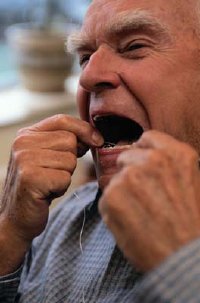
©2006 Publications International, Ltd.
With arthritis, daily activities like
flossing can put a lot of stress
on your joints.
|
Assistive equipment or adaptive devices are tools used to simplify activities of daily living. These can vary from simple, inexpensively constructed items to complex custom-designed gadgets. Assistive devices have four basic functions: to compensate for lost function; to alleviate joint stress; to decrease energy demands; and to increase safety.
You should not use assistive equipment when you are physically able to complete an activity without excessive joint stress, fatigue, or risk of injury. After all, the demands of daily activities can help you maintain strength and range of motion. Sometimes, you may be able to modify the way you do something rather than using supportive equipment. However, there are bound to be times when activities are more difficult for you, and you will need the help of an assistive device.
There are an amazing array of devices available. Some have even hit the mainstream. For example, you are likely to find built-up, padded eating utensils, vegetable peelers, and the like in cooking and housewares stores. Other devices may be a bit harder to find.
Check local stores that sell medical supplies and convalescent aids; they may stock some items, be able to order others, or at least have catalogues through which you may be able to order such devices yourself. You can also contact an occupational therapist in your area and ask where assistive devices can be obtained. Another option for some assistive devices is to make your own or modify tools you already have. Here is a sampling of the types of assistive devices available:
Food-Preparation and Eating Aids:
- A special tool for opening sealed cartons, such as cereal boxes
- Jar, bottle, and can openers that are easy on the hands. Some even mount under cabinets.
- A plastic milk-carton holder with a handle to make pouring easier
- Utensils with foam-padding around the handles for easier, more comfortable gripping. You can make these yourself by slipping foam-rubber curlers around the handles of your utensils. Foam-rubber tubing that can be cut to fit is also available. If gripping built-up utensils is still too difficult or painful, you can get utensils that have a hand clip; the clip hooks onto your hand so you don't have to grip the utensil at all.
- Built-up kitchen tools such as paring knives, vegetable peelers, and pizza cutters
- A cutting board with a small spike or high edges at one corner to hold food in place and make cutting easier
Hygiene Aids:
- Floss holders and threaders
- A toothpaste-tube holder that squeezes the tube for you. You could also buy a brand of toothpaste that comes in a pump dispenser and just use your palm or the edge of your hand to push the pump.
- A nail brush attached to a base that has suction cups on it. You attach the brush to the counter using the suction cups, so you don't have to hold the brush in your fingers. Nail clippers in a similar type of base are also available.
- Built-up grooming aids such as toothbrushes, brushes, and razors, as well as brushes and combs that have long, bendable handles
- An accordion-style holder for your blow dryer that allows hands-free drying. The holder screws into the wall and allows you to adjust the angle and position of the dryer.
- Devices that raise the height of your toilet seat for easier use
Dressing Aids: - Shoe fasteners that slip onto your laces so you don't have to tie them. You could also choose slip-on shoes or shoes with Velcro closures.
- Shoe- and boot-removing devices that don't require bending over
- Button loops for easier buttoning and unbuttoning
- Dressing aids, such as loops and pinchers with handles of various lengths, that make it easier to put on socks, hose, pants, sweaters, and other clothing
Writing and Reading Aids: - Assorted pencil and pen holders and foam pads to make writing more comfortable
- Special scissors that put less strain on the fingers
- Book holders and page turners
Miscellaneous Aids:
- An oversized lamp switch that makes it easier to turn the knobs of table and floor lamps
- Playing-card holders and shufflers
- A phone holder with a hand clip that allows you to bring the receiver to your ear without wrapping your fingers around the receiver
- A device that makes it easier to pull an electrical plug out of the socket
- A device for opening car doors that have push-button style handles
Get a Handle on LifeLong handles can be lifesavers -- or at least joint savers -- for the person with arthritis. Using a long handle on everyday tools can help in three ways. It can help increase leverage, which means you have to exert less force and spend less energy. It can allow you to use a stronger or larger joint to perform a task. And it can help extend your reach, so you don't have to strain or place yourself in a dangerous or uncomfortable position.
To appreciate the benefits of a long handle, consider a faucet with traditional knobs. Turning the knobs applies considerable stress to the fingers and requires a fair amount of strength. If you replace the knobs with long-handled levers (available in home-improvement stores), you increase your leverage and spare your finger joints. If you can't replace your faucet knobs, you can obtain a device that fits over them and creates the same effect; check specialty catalogues or medical-supply stores.
These tips can help you get a better handle on life:
- A device similar to the one that you put on faucet knobs can be used on door knobs. You might even consider replacing your door knobs with handles.
- If turning a key is difficult, attach a homemade handle that allows you to grasp and turn with your whole hand rather than just your fingers. Key holders designed for this purpose are available through specialty catalogues and some medical-supply stores.
- Use a knife to open the flip top of a soda can.
- Use long-handled "pinchers," like those used in stores, to reach light items on high shelves, remove laundry from the dryer, or pick small items off the floor.
- Attach a long handle to a dust pan or sponge to make cleaning easier.
- Use a long-handled shoe horn to put on shoes.
- Slip the hooks of two coat hangers into the loops of your pants and use them to help pull your pants up.
Organize Your KitchenIt may sound like a bit of a contradiction to talk of making chores like cooking and cleaning more comfortable. For people with arthritis, however, making these tasks easier on the joints (and on the body as a whole) may be the only way to make them doable.
You can use several basic strategies to make cooking and other household chores...well, less of a chore.
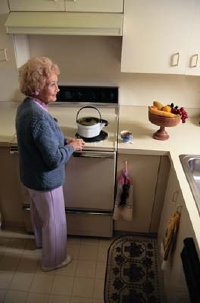
©2006 Publications International, Ltd.
With a little planning, you reorganize
your kitchen so that simple chores
don't take such a toll on your body.
|
- Adapt the environment to maximize function and conserve energy. In your kitchen, laundry room, or workshop, set up a special place to do certain tasks that use similar equipment. This way, you can keep all the necessary supplies within easy reach. You might even consider duplicating inexpensive items that need to be used in more than one location (get a couple of brooms and dustpans so you can keep one set in the kitchen and one set in the workshop, for example). And if possible, keep a stool or chair near each so that you can sit, or half-sit half-stand, for as many tasks as possible.
To get an idea of what we mean, consider the kitchen. Some of your basic kitchen chores probably include food preparation, cooking/baking, and cleaning up. So try to set up stations for each of these tasks that have all or nearly all of the necessary supplies in them. In your food-preparation station, for example, include various types of knives, cutting boards, mixing bowls, a rolling pin, and other food-prep equipment. In the cooking area, which you should set up by the stove, keep pots, pans, lids, cooking utensils, seasonings, potholders, and the like within easy reach.
Consider storing the cooking utensils in easy-access ceramic jugs on the counter nearest the range. In the clean-up center, place your detergent, scrubbers, dish towels, and sponges within arms reach. The more-conveniently placed these items are, the less energy you will waste hunting around for them and moving them back and forth. If you simply don't have the space to keep everything you need in these areas, consider wearing an apron with pockets so you can carry utensils, measuring spoons, and other small items from station to station.
- If possible, store often-used cleaning and cooking supplies on shelves and counters that are between hip and shoulder level. Crouching down to pull supplies out of low shelves or straining to reach high ones can be exhausting and even dangerous. Stock those tougher-to-reach shelves with items that you don't use as often, being sure to put the heavy ones on the low shelves and the light ones above.
- Use labor-saving appliances whenever you can. If possible, invest in a dishwasher, a food processor for chopping and cutting, an electric can opener, a snow and/or leaf blower, a riding mower, or other appliances that will help you conserve energy and give your joints a break. When choosing them, look for joint-friendly features. For portable tools, look for those that are lightweight and easy to handle. When selecting a vacuum, consider getting the type that has all attachments aboard the machine. Be sure it rolls easily on carpets and floors. Look for an on-off switch that can be triggered with your foot, so you don't have to bend over. For other appliances, such as blenders and food processors, look for those with buttons or levers rather than knobs that you have to twist; this way, you can use your palm or the side of your hand, rather than your fingers, to work them.
- If you can't afford certain appliances, look for nonelectric aids. For example, if you can't afford a food processor, ease your chopping chores by getting a manual chopper. This device is basically a cylinder that has a blade attached to a plunger. To chop foods like onions, you simply place the chopper over the onion and, with the palm of your hand, press down several times, depending on the type of cut you need. Also, be sure that kitchen knives and scissors are kept sharp; dull knives force you to grip and press harder and waste energy.
Look for energy-saving cleaning supplies as well. Get a dustpan with a long handle and a mop with a wringer that you can operate without bending over. If you use a duster or blind cleaner, get one with a long handle, or try attaching a lightweight handle to the one you have.
Don't Forget About WorkDon't forget to check your workplace for ways to conserve energy and protect your joints. The adjustments you can make in this realm, of course, depend on the type of work you do as well as other factors. Some troublesome tasks or situations you may not be able to change, but it's worth the effort to find those that you can. Some of these tips may help:
- If you sit much of the day, get a supportive chair.
- If your job requires a lot of standing or walking, choose shoes with plenty of cushioning and support and a heel no higher than one inch.
- Whether you sit, stand, or walk all day, use proper posture.
- If possible, adjust the height of your work surface or seat so you're not constantly stooping or bending your joints in stressful positions. If you do a lot of writing or reading, get a portable drafting board or book holder to put on your desk. The board can be set at an angle, so you don't have to hunch over your desk.
- If you spend lots of time on the phone, try a headpiece receiver to lessen stress on your joints.
- Avoid long periods of repetitive movement -- whether it's turning bolts on machinery or typing at a computer. See if you can break up tasks that require repetitive movements with those that don't. If your job is a repetitive movement, talk to your boss about the possibility of rotating jobs with other workers.
- Organize your work area so that commonly used tools are within easy reach. If you work in more than one area, use an apron, tool belt, or lightweight tote to lug needed items with you.
- Take rest breaks and stretch your muscles at regular intervals. If you stand all day, sit during your break. If you sit for hours, get up and walk -- even if it's just to the bathroom.
Unfortunately, aches and stiffness goes hand in hand with a diagnosis of arthritis. While you'll never be able to reclaim the flexibility of your youth, there are steps you can take to avoid pain and injury. If you follow our simple suggestions, you should be able to keep your arthritis pain at bay.
ABOUT THE AUTHOR:
Diana L. Anderson, Ph.D., is the author of 50 Ways to Cope with Arthritis and a past First-Vice President of the Association of Rheumatology Professionals. She is the President, CEO and founder of D. L. Anderson International, Inc., parent company to subsidiary D. Anderson & Company, a patient recruitment and retention provider and is recognized internationally as an expert in her field. For more information, visit her website at www.dandersoncompany.com.
ABOUT THE CONSULTANTS:
Eric Gall, M.D., is a professor and chairman of the Department of Medicine, professor of microbiology and immunology, and chief of the Division of Rheumatology at the Chicago Medical School of Rosalind Franklin University of Medicine & Science. He is a master of the American College of Rheumatology and the American College of Physicians and former president of the Association of Rheumatology Health Professionals. He has a long-time interest in multidisciplinary care of arthritis and is active in both the national and local chapters of the Arthritis Foundation.
Paul Katz, M.D., is Professor and Vice Chairman, Department of Medicine and Chief of the Division of Rheumatology, Immunology and Allergy, at Georgetown University Medical Center. Dr. Katz serves on the Council on Education of the American College of Rheumatology and is a member of the Government Affairs Committee of the Arthritis Foundation.
This information is solely for informational purposes. IT IS NOT INTENDED TO PROVIDE MEDICAL ADVICE. Neither the Editors of Consumer Guide (R), Publications International, Ltd., the author nor publisher take responsibility for any possible consequences from any treatment, procedure, exercise, dietary modification, action or application of medication which results from reading or following the information contained in this information. The publication of this information does not constitute the practice of medicine, and this information does not replace the advice of your physician or other health care provider. Before undertaking any course of treatment, the reader must seek the advice of their physician or other health care provider.