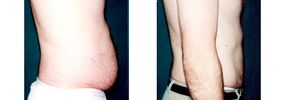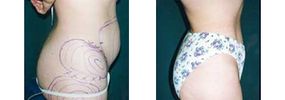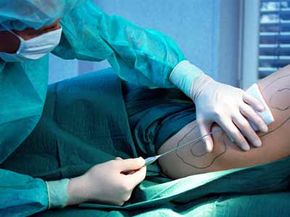
How do so many celebrities stay super skinny? Undoubtedly, many of them do it the old fashioned way, by sticking to strict diets and exercise programs. But at least a few have acquired their tight thighs, flat tummies and quarter-bouncing buns in a plastic surgeon's office, even if they're reluctant to admit it.
Celebrities aren't the only ones getting a sleeker look with surgery. Doctors perform an estimated 500,000 liposuction procedures in the United States each year, making it the most popular type of cosmetic surgery, according to the American Society for Dermatologic Surgery.
Advertisement
In this article, we'll find out how liposuction is performed, learn what it's like to have the procedure done and find out what risks are involved.
Most people know that liposuction involves removing fat from certain parts of the body to create a more streamlined shape. But how exactly does it work?
First, what is fat? It is tissue (otherwise known as adipose tissue) made up of cells that store energy and insulate the body. Fat is generally subcutaneous -- located underneath the skin. Where fat is deposited around the body depends on a person's gender. In men, fat tends to congregate in the chest, abdomen and buttocks. In women, it generally gathers in the breasts, hips, waist and buttocks.
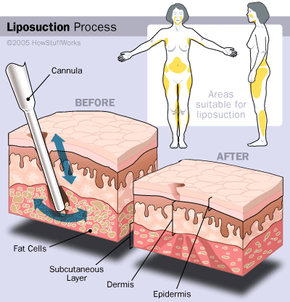
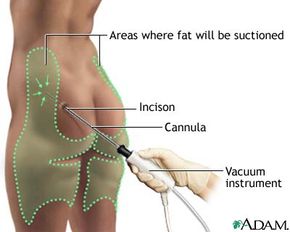
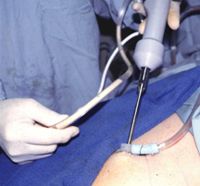
There are two layers of subcutaneous fat: deep and superficial. During a liposuction procedure (also known as lipoplasty or suction lipectomy), the doctor makes a tiny incision and inserts a hollow, stainless-steel tube (called a cannula) into the deep fat layer. Working on this layer is safer than working on the superficial layer, because there is less risk of injuring the skin. In a typical procedure, the doctor pushes and pulls the tube through the fat layer (a new technique, power liposuction, automates the movement). As the cannula moves, it breaks up fat cells, and a vacuum pump or syringe removes the fat with suction.
On the next page, learn about the risks and considerations involved with liposuction.
Advertisement