Roses are red, violets are blue -- well, bluish. The sky is blue, too. Grass is green. These are things that most of us know for a fact and don't question. But what if you were colorblind? What would you see? Is life one long black-and-white movie?

MGM Studios/Getty Images
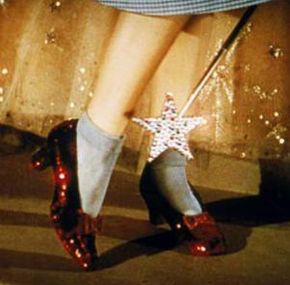
Dorothy's ruby slippers wouldn't have been the same in black-and-white. See more human senses pictures.
Try this activity from Discovery Channel -- test your sight and learn how vision works at the same time! Other interactive segments let you explore your body's systems and see how they help you move through your daily life. |
In "The Wizard of Oz," Dorothy Gale steps out of her black-and-white Kansas farmhouse and into the color-saturated Land of Oz. She moves from a humdrum existence of chores and troubles to an intense fantasyland peopled with curious creatures, trading in a clapboard house for yellow brick roads, red ruby slippers and a brilliant green city of emeralds. What would her transformation have been without this rainbow of colors?
Color isn't just a component of vision. We associate color with beauty, like in a gorgeous sunset. Some colors have meaning in and of themselves -- purple is for royals, red signifies passion. Colors seep into our expressions -- If we're depressed, we say we're feeling blue. We're also "green with envy," we "see red" and we might go "white with fear." Colors even have practical meaning -- red means stop, green means go.
Certain colors are said to help you sleep, while others make you hungry. And never underestimate the effect of a bright red dress. Color is important.
In this article, we're going to learn what the world looks like for someone who's colorblind.
Contrary to popular belief, dogs and cats don't see in shades of gray. They do see colors, just not all of the colors. Apes and some monkeys see like us. Raccoons are colorblind, and so are whales and seals, but manatees can tell blue from green. Birds see even better than we do. Lots of animals also have ultraviolet vision -- from birds to bugs, fish to lizards. Interestingly, after an injury or an event like cataract surgery, some humans gain ultraviolet vision. When the lens of a person's eye has been removed, the condition is called aphakia. Some people think Monet had the condition after his cataract surgery -- he claimed that the colors he saw had completely changed and were in fact "quite terrifying" [source: Fortune]. (Bonus fact: The urine of many rodent species reflects ultraviolet light, which may be why rodents have retained UV vision, unlike other mammals [source: National Geographic].) |