In a study published in the July 2007 issue of Analytical Chemistry, scientists from Purdue University detailed their use of gold nanoparticles to detect breast cancer. Their work, along with similar studies at other universities, has the potential to radically change breast cancer detection.
The procedure works by identifying the proteins found on the exteriors of cancer cells. Different types of cancer have different proteins on their surfaces that serve as unique markers. Nanorods, gold nanoparticles shaped like rods, use specialized antibodies to latch onto the protein markers for breast cancer, or for another cancer type. After the nanorods bind to proteins in a blood sample, scientists examine how they scatter light. Each protein-nanorod combination scatters light in a unique way, allowing for precise diagnoses.
Advertisement
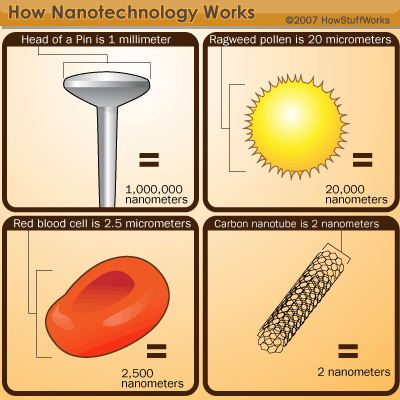
The use of gold nanoparticles is not new to this study. These tiny particles -- it would take 500 of them to span the width of a human hair -- are particularly suited to detect toxins, pathogens and cancers and are a subject of much experimentation [Source: BBC News]. The scientists at Purdue used nanorods capable of attaching to three types of breast cancer markers, with two of the markers identifying how invasive the cancer is. The lead researcher on the study, Joseph Irudayaraji, said that these nanorods could one day form part of a much more thorough test, binding to up to 15 unique markers [Source: Physorg].
Using nanorods cuts the price of the diagnosis by two-thirds compared to the similar method of flow cytometry, in which fluorescent markers bind to cancer cells. Flow cytometry requires a bigger sample size with thousands of times more cells than is needed for nanorods, meaning that nanorods are capable of helping to determine earlier diagnoses. Nanorods prove much less invasive than some other methods because they use blood samples and don't require a biopsy. Part of the cost savings comes from scientists being able to use a conventional microscope and light source to view the samples, unlike other methods that employ expensive microscopes or lasers.
In a different study, Dr. Irudayaraj showed that gold nanorods could be used to detect cancer stem cells. The discovery is particularly valuable because cancer stem cells cause the out-of-control growth that makes malignant tumors so deadly.
Dr. Irudayaraji said that gold nanoparticles could be widely available for cancer diagnoses sometime in 2011.
Besides being part of exhaustive tests that can detect cancers early on, nanoparticles may also form the basis of future cancer treatments. Lasers that react with gold nanoparticles could be used to destroy cancer cells. Or, nanoparticles could be used as targeted drug-delivery systems.
On the next page, we'll examine these efforts to use nanotechnology to fight cancer and some of the dangers involved.
Advertisement