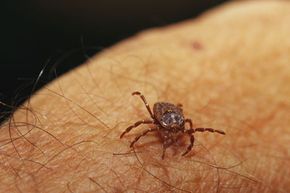
A tick attaches itself to the skin of a human, animal, or reptile and feeds on the host's blood. Each kind of tick usually has a favorite host, and humans are fed on in the absence of a tick's favorite kind of blood.
The tick may not be found until after it has enlarged from feeding on your blood, which could take several days.
The immature form of the deer tick is quite small (about the size of a pencil tip) and hard to see, even after it feeds. Despite their small stature, deer ticks transmit diseases, including Lyme disease, that can cause big problems. If left untreated, Lyme disease can spread infection to the heart, joints, and nervous system. The disease has hit every state, but it is particularly common in New England, parts of the Midwest, and northern California.
Dog ticks are larger and more noticeable than deer ticks; the adults often get as large as one-half inch in length and can enlarge to the size of a marble if left alone. As their name suggests, dog ticks frequently live on the family pet, latching on to ears and other succulent areas. Dog ticks also carry diseases, including Rocky Mountain spotted fever, a bacterial infection characterized by fever, rash, and nausea. If left untreated, Rocky Mountain spotted fever can be fatal.
The Culprit
Ticks are tiny brown mites that, like spiders, are arachnids. Hundreds of different kinds of ticks exist, but dog ticks and deer ticks are very prevalent in the United States.
Who's at Risk?
Ticks can hitch an unwelcome ride on anyone, but people who spend time outdoors in tall grasses or wooded areas are at greater risk. Being in prolonged, close contact with pets that may be infested with ticks also makes you vulnerable. Always check children for ticks after they spend time in high-risk outdoor areas.
Defensive Measures
There's no need to board up the windows and doors and shut yourself in -- you can still enjoy the great outdoors despite its smallest inhabitants. You just need to take a few precautions to ensure you don't become a host for these petite parasites:
- Check your pets for ticks if they spend time outside. You should also add a flea and tick collar or other pest deterrent to your pet's hygiene regimen. Your veterinarian can suggest safe and effective products.
- If you are going to walk or hike, stay on a trail rather than venturing through tall grasses, trees with low branches, or piles of dry leaves. Also, stay in areas that get plenty of sun and don't sit directly on the ground.
- Wear long sleeves and light-colored long pants when outside. The extra coverage deters ticks from crawling onto skin, and lighter colors help you see the little bloodsuckers.
- Consider tucking your pant legs into your socks so ticks can't crawl inside. If you are in an area you suspect may be infested with ticks, wear a hat.
- Some experts suggest using a bug spray that contains 10 percent DEET before going into high-risk outdoor areas. Just be sure to wash off the bug spray when you go inside. Although DEET is very effective against mosquitoes, it doesn't have the same success rate when it comes to ticks.
- When you return from walking or hiking, check your clothing and skin for ticks. Run your fingers over your skin and through your hair, and be sure to check your ears, underarms, and groin.
If a tick is latched on to your skin, grab some tweezers and a small vial, such as a film container or small glass bottle. Using the tweezers, grasp the tick as close to its imbedded head as possible, then slowly pull it straight out of the skin. Put the tick in the vial so your physician can identify the species.
Some authorities might recommend preventative antibiotics based on the geographic area where the tick was acquired and the kind of tick identified. If done correctly, the tick will usually still be alive after you pull it out of the skin, so be sure the container is clsed properly. Wash your hands and watch the bite area for unusual redness or swelling.
Now that you've read about parasitic infections including body lice, scabies, and ticks, do yourself a favor and take the necessary steps to prevent acquiring these infections.
ABOUT THE AUTHOR:
Laurie L. Dove is an award winning Kansas-based journalist and author whose work has been published internationally. A dedicated consumer advocate, Dove specializes in writing about health, parenting, fitness and travel. An active member of the National Federation of Press Women, Dove also is the former owner of a parenting magazine and a weekly newspaper.
ABOUT THE CONSULTANT:
Dr. Larry Lutwick is a Professor of Medicine at the State University of New York - Downstate Medical School in Brooklyn, New York and Director of Infectious Diseases, Veterans Affairs New York Harbor Health Care System, Brooklyn Campus. He is also Bacterial Diseases Moderator for the real time online infectious diseases surveillance system, Program for Monitoring Emerging Diseases (ProMED-mail) and has authored more than 100 medical articles and 15 book chapters. He has edited two books on infectious diseases.
This information is solely for informational purposes. IT IS NOT INTENDED TO PROVIDE MEDICAL ADVICE. Neither the Editors of Consumer Guide (R), Publications International, Ltd., the author nor publisher take responsibility for any possible consequences from any treatment, procedure, exercise, dietary modification, action or application of medication which results from reading or following the information contained in this information. The publication of this information does not constitute the practice of medicine, and this information does not replace the advice of your physician or other health care provider. Before undertaking any course of treatment, the reader must seek the advice of their physician or other health care provider.