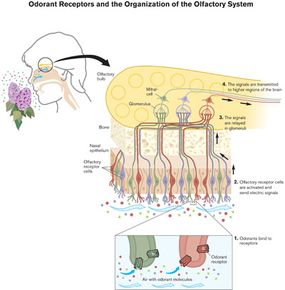
Smell is often our first response to stimuli. It alerts us to fire before we see flames. It makes us recoil before we taste rotten food. But although smell is a basic sense, it's also at the forefront of neurological research. Scientists are still exploring how, precisely, we pick up odorants, process them and interpret them as smells. Why are researchers, perfumers, developers and even government agencies so curious about smell? What makes a seemingly rudimentary sense so tantalizing?
Smell, like taste, is a chemical sense detected by sensory cells called chemoreceptors. When an odorant stimulates the chemoreceptors in the nose that detect smell, they pass on electrical impulses to the brain. The brain then interprets patterns in electrical activity as specific odors and olfactory sensation becomes perception -- something we can recognize as smell. The only other chemical system that can quickly identify, make sense of and memorize new molecules is the immune system.
Advertisement
But smell, more so than any other sense, is also intimately linked to the parts of the brain that process emotion and associative learning. The olfactory bulb in the brain, which sorts sensation into perception, is part of the limbic system -- a system that includes the amygdala and hippocampus, structures vital to our behavior, mood and memory. This link to brain's emotional center makes smell a fascinating frontier in neuroscience, behavioral science and advertising.
In this article, we'll explore how humans perceive smell, how it triggers memory and the interesting (and sometimes unusual) ways to manipulate odor and olfactory perception.
Advertisement