Introduction to How Diabetes Works
|
Types of Diabetes
|
Odds are that you know someone with diabetes mellitus, possibly even someone who has to take insulin each day to manage the disease. Diabetes is a growing health problem in the United States and has risen about six-fold since 1950, now affecting approximately 20.8 million Americans. About one-third of those 20.8 million do not know that they have the disease. Diabetes-related health care costs total nearly $100 billion per year and are increasing. Diabetes contributes to over 200,000 deaths each year.
To understand diabetes, you first need to know about how your body uses a hormone called insulin to handle glucose, a simple sugar that is its main source of energy. In diabetes, something goes wrong in your body so that you do not produce insulin or are not sensitive to it. Therefore, your body produces high levels of blood glucose, which act on many organs to produce the symptoms of the disease.
In this article, we will examine this serious disease. We will look at how your body handles glucose. We'll find out what insulin is and what it does, how the lack of insulin or insulin-insensitivity affects your body functions to produce the symptoms of diabetes, how the disease is currently treated and what future treatments are in store for diabetics.
|
|
Insulin, Glucagon and Blood Glucose
Since diabetes is a disease that affects your body's ability to use glucose, let's start by looking at what glucose is and how your body controls it. Glucose is a simple sugar that provides energy to all of the cells in your body. The cells take in glucose from the blood and break it down for energy (some cells, like brain cells and red blood cells, rely solely on glucose for fuel). The glucose in the blood comes from the food that you eat.
![]() A glucose molecule |
When you eat food, glucose gets absorbed from your intestines and distributed by the bloodstream to all of the cells in your body. Your body tries to keep a constant supply of glucose for your cells by maintaining a constant glucose concentration in your blood -- otherwise, your cells would have more than enough glucose right after a meal and starve in between meals and overnight. So, when you have an oversupply of glucose, your body stores the excess in the liver and muscles by making glycogen, long chains of glucose. When glucose is in short supply, your body mobilizes glucose from stored glycogen and/or stimulates you to eat food. The key is to maintain a constant blood-glucose level.
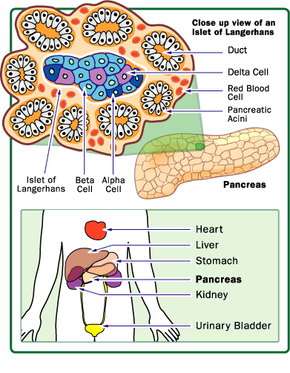
To maintain a constant blood-glucose level, your body relies on two hormones produced in the pancreas that have opposite actions: insulin and glucagon.
![]() The pancreas has many islets that contain insulin-producing beta cells and glucagon-producing alpha cells. |
|
|
- Stimulates liver and muscle cells to store glucose in glycogen
- Stimulates fat cells to form fats from fatty acids and glycerol
- Stimulates liver and muscle cells to make proteins from amino acids
- Inhibits the liver and kidney cells from making glucose from intermediate compounds of metabolic pathways (gluconeogenesis)
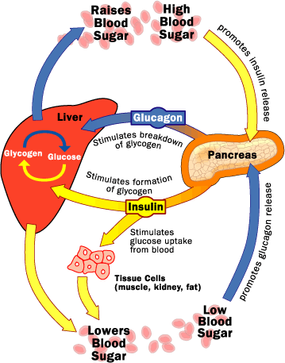
![]() Insulin and glucagon have opposite effects on liver and other tissues for controlling blood-glucose levels. |
|
|
- Stimulates the liver and muscles to break down stored glycogen (glycogenolysis) and release the glucose
- Stimulates gluconeogenesis in the liver and kidneys
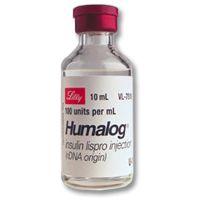
![]() Photo courtesy Eli Lilly & Company Insulin is what diabetics lack -- and what they need for treatment. |
In contrast, when you are between meals or sleeping, your body is essentially starving. Your cells need supplies of glucose from the blood in order to keep going. During these times, slight drops in blood-sugar levels stimulate glucagon secretion from the pancreatic alpha cells and inhibit insulin secretion from the beta cells. Blood-glucagon levels rise. Glucagon acts on liver, muscle and kidney tissue to mobilize glucose from glycogen or to make glucose that gets released into the blood. This action prevents the blood-glucose concentration from falling drastically.
As you can see, the interplay between insulin and glucagon secretions throughout the day help to keep your blood-glucose concentration constant, staying at about 90 mg per 100 ml of blood (5 millimolar).
|
|
Diabetes
Now that you know how your body handles glucose with insulin and glucagon, you are ready to understand diabetes. Diabetes is classified into three types: Type 1, Type 2 and gestational diabetes.
|
|
Type 2 (also called adult-onset diabetes or non-insulin-dependent diabetes) occurs when the body does not respond or can't use its own insulin (insulin resistance). Type 2 occurs in 90 percent to 95 percent of diabetics and usually occurs in adults over the age of 40, most often between the ages of 50 and 60. Type 2 diabetics have an abnormal glucose-tolerance test and higher than normal levels of insulin in their blood. In Type 2 diabetics, the insulin resistance is linked to obesity, but we do not know exactly how this occurs. Some studies suggest that the number of insulin receptors on liver, fat and muscle cells is reduced, while others suggest that the intracellular pathways activated by insulin in these cells are altered.
Gestational diabetes can occur in some pregnant women and is similar to Type 2 diabetes. Gestational diabetics have an abnormal glucose-tolerance test and slightly higher levels of insulin. During pregnancy, several hormones partially block the actions of insulin, thereby making the woman less sensitive to her own insulin. She develops a diabetes that can be managed by special diets and/or supplemental injections of insulin. It usually goes away after the baby is delivered.
Regardless of the type of diabetes, diabetics exhibit several (but not necessarily all) of the following symptoms:
- Excessive thirst (polydipsia)
- Frequent urination (polyuria)
- Extreme hunger or constant eating (polyphagia)
- Unexplained weight loss
- Presence of glucose in the urine (glycosuria)
- Tiredness or fatigue
- Changes in vision
- Numbness or tingling in the extremities (hands, feet)
- Slow-healing wounds or sores
- Abnormally high frequency of infection
These symptoms can be understood when we see how insulin deficiency or insulin resistance affects the body's physiology.
Insulin Ineffectiveness
Now that you know the symptoms of diabetes -- high blood glucose, excessive hunger and thirst, frequent urination -- let's look at what happens to your body during diabetes. For the purposes of this discussion, let's suppose that you have undiagnosed, and therefore unmanaged, diabetes.
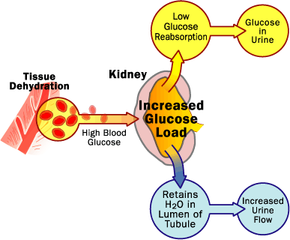
![]() The high blood glucose in diabetes produces glucose in the urine and frequent urination through effects on the kidneys. |
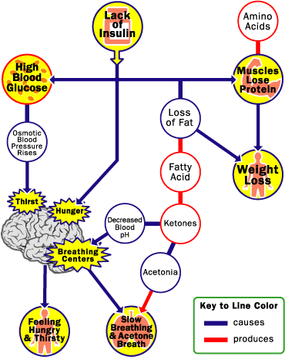
Now, let's see how the lack of insulin or insulin-resistance affects your body to produce the clinical symptoms and signs of diabetes:
- Your lack of insulin or insulin resistance directly causes high blood-glucose levels during fasting and after a meal (reduced glucose tolerance).
- Because your body either does not produce or does not respond to insulin, your cells do not absorb glucose from your bloodstream, which causes you to have high blood-glucose levels.
- Because your cells have no glucose coming into them from your blood, your body "thinks" that it is starving.
- Your pancreatic alpha cells secrete glucagon, and glucagon levels in your blood rise.
- Glucagon acts on your liver and muscles to breakdown stored glycogen and release glucose into the blood.
- Glucagon also act on your liver and kidneys to produce and release glucose by gluconeogenesis.
- Both of these actions of glucagon further raise your blood-glucose levels.
- High blood glucose causes glucose to appear in your urine.
- High blood-glucose levels increase the amount of glucose filtered by your kidneys.
- The amount of glucose filtered exceeds the amount that your kidneys can reabsorb.
- The excess glucose gets lost into the urine and can be detected by glucose test strips (see How Your Kidneys Work for details on filtration and reabsorption).
- High blood glucose causes you to urinate frequently.
- High blood glucose increases the amount of glucose filtered by your kidneys.
- Because the filtered load of glucose in your kidneys exceeds the amount that they can reabsorb, glucose remains inside the tubule lumen.
- The glucose in the tubule retains water, which increases urine flow through the tubule.
- The increased urine flow causes you to urinate frequently.

The lack of insulin or insulin resistance acts on many organs to produce a variety of effects.
- The high blood glucose and increased urine flow make you constantly thirsty.
- High blood-glucose levels increase the osmotic pressure of your blood and directly stimulate the thirst receptors in your brain.
- Your increased urine flow causes you to lose body sodium, which also stimulates your thirst receptors.
- You are constantly hungry. It's not clear exactly what stimulates your brain's hunger centers, possibly the lack of insulin or high glucagon levels.
- You lose weight despite the fact that you are eating more frequently. The lack of insulin or insulin-resistance directly stimulates the breakdown of fats in fat cells and proteins in muscle, leading to weight loss.
- Metabolism of fatty acids leads to the production of acidic ketones in the blood (ketoacidosis), which can lead to breathing problems, the smell of acetone on your breath, irregularities in your heart and central-nervous-system depression, which leads to coma.
- You feel tired because your cells cannot absorb glucose, leaving them with nothing to burn for energy.
- Your hands and feet may feel cold because your high blood-glucose levels cause poor blood circulation.
- High blood glucose increases the osmotic pressure of your blood.
- The increased osmotic pressure draws water from your tissues, causing them to become dehydrated.
- The water in your blood gets lost by the kidneys as urine, which decreases your blood volume.
- The decreased blood volume makes your blood thicker (higher concentration of red blood cells), with a consistency like molasses, and more resistant to flow (poor circulation).
- Your poor blood circulation causes numbness in your hands and feet, changes in vision, slow-healing wounds and frequent infections. High blood glucose or lack of insulin may also depress the immune system. Ultimately, these can lead to gangrene in the limbs and blindness.
Treatments
As of now, there is no cure for diabetes; however, the disease can be treated and managed successfully. The key to treating diabetes is to closely monitor and manage your blood-glucose levels through exercise, diet and medications. The exact treatment regime depends on the type of diabetes.
|
|
If you have Type 1 diabetes, you lack insulin and must administer it several times each day. Insulin injections are usually timed around meals to cope with the glucose load from digestion. You must monitor your blood-glucose levels several times a day and adjust the amounts of insulin that you inject accordingly. This keeps your blood-glucose concentration from fluctuating wildly.
|
|
If you have Type 2 diabetes, you can usually manage it by reducing your body weight through dieting and exercise. You may have to monitor your blood glucose either daily or just when you visit your doctor. Depending on the severity of your diabetes, you may have to take medication to aid in controlling your blood glucose. Most of the medicines for Type 2 diabetes are oral medications, and their actions fall into the following categories:
- Stimulating the pancreas to release more insulin to help reduce blood glucose
- Interfering with the absorption of glucose by the intestine, thereby preventing glucose from entering the bloodstream
- Improving insulin sensitivity
- Reducing glucose production by the liver
- Helping to breakdown or metabolize glucose
- Supplementing insulin directly in the bloodstream through injections
|
According to the head of Duke's islet-cell transplant program, Dr. Emmanuel Opara, the hope is that this finding could end the insulin injections that millions of people take daily for the treatment of Type 1 diabetes. The research may also benefit a small number of Type 2 diabetes patients who require daily insulin injections because they are unable to process insulin properly (versus most Type 2 cases, in which the body does not produce insulin correctly). |
- Acupuncture - This is an Eastern medical treatment whereby needles are inserted at various centers in the body to release natural painkillers, which may help in managing painful nerve damage in diabetes.
- Biofeedback - This psychological technique involves using meditation, relaxation and stress-reduction methods to manage and relieve pain.
- Chromium - Additional chromium in your diet may help your body make a glucose-tolerance factor that helps improve insulin action. However, the scientific information on chromium supplementation in diabetes is insufficient, and no consensus exists.
- Magnesium - Diabetics tend to be deficient in magnesium, which can worsen the complications of diabetes, especially Type 2. The exact nature of the relationship between magnesium and diabetes is still under research, and no consensus has been reached.
- Vanadium - Vanadium may normalize blood glucose in Type 1 and 2 diabetic animals, but there is not enough information available for humans. This area is currently under research.
One of the most promising developments for future, perhaps permanent, treatments for Type 1 diabetes is pancreatic islet transplantation. In this technique, islets are removed from the pancreas of a deceased donor and injected through a thin tube (catheter) into the liver of a diabetic patient. After some time, the islet cells attach to new blood vessels and begin releasing insulin. Although early studies have shown some success, rejection of the donor's tissue is a major problem. Research continues in this field because of its great potential to treat diabetes.
To learn more about diabetes and related topics, check out the links on the next page.
Lots More Information
Related HowStuffWorks Articles
- Type 1 Diabetes
- Type 2 Diabetes
- Gestational Diabetes
- Rare Forms of Diabetes
- Causes of Diabetes
- Diabetes Symptoms
- Diabetes Diagnosis
- Diabetes Treatment
- Diabetic Diet
- Living with Diabetes
- Diabetic Recipes
- How Your Kidneys Work
- How Food Works
- How Cells Work
- How Fat Cells Work
- How Fats Work
- How Blood Works
- How Muscles Work
- How Your Immune System Works
- How Prenatal Testing Works
- How Exercise Works
- How Calories Work
- How Dieting Works
More Great Links
- American Diabetes Association Home Page
- Diabetes Research Institute
- The Diabetes Mall
- Joslin Diabetes Center
- Juvenile Diabetes Foundation International